The Hidden Cost of Reading Lyrics on Stage
You know the moment. The performer glances down. Just for a second. And something in the room shifts.
Nobody in the audience says anything. Nobody boos. They keep watching, keep nodding along. But the spell breaks. The energy that was building between the person on stage and the people watching — that invisible thing that makes a live performance feel different from a recording — goes quiet. And it doesn't fully come back, even after the phone goes back in the pocket or the sheet gets flipped.
This happens hundreds of times every night in bars, at weddings, at open mics, at corporate events. Musicians glancing at phones propped on amp tops. Sheets tucked into music stands. Tablets mounted on mic stands. The technology changes; the cost stays the same. And most performers have no idea how visible it is — or how much it matters.
What the audience actually sees
Here's the uncomfortable truth: audiences are exquisitely sensitive to eye contact, and they process its absence before they can consciously name it. When a performer looks away — down at a screen, sideways at a sheet — viewers don't think "oh, they're reading their lyrics." They feel something more diffuse: this person isn't quite here with us. A mild but real disappointment, the social equivalent of someone checking their phone mid-conversation.
This isn't speculation. Research on gaze and social cognition has consistently shown that mutual gaze is one of the most powerful signals of presence, engagement, and interpersonal connection available to humans. Adam Kendon's foundational 1967 studies on eye contact established that gaze functions as a social regulator — it signals attention, signals turn-taking, signals sincerity.1 When the signal is absent, the brain notices, and it interprets the absence as disconnection.
A 2007 review by Frischen, Bayliss, and Tipper synthesized decades of research on gaze cueing and concluded that direct gaze activates fundamentally different social-cognitive processing than averted gaze — it triggers attention, affiliation, and approach responses in the observer.2 In plain English: looking at someone makes them feel seen. Not looking at them makes them feel like an audience rather than a participant.
Which is the last thing you want in a live performance.
Presence, flow, and why it looks the way it looks
There's another thing that happens when a performer genuinely doesn't need a safety net, and it's harder to define but impossible to miss: they enter flow.
Psychologist Mihaly Csikszentmihalyi described flow as complete absorption in an activity — the state in which challenge and skill are perfectly matched, self-consciousness disappears, and time distorts.3 Musicians describe it as "being in the zone." Audiences describe it as "magic," or simply "they were incredible tonight." What they're observing is someone for whom the cognitive task of remembering the lyrics has dropped below the threshold of attention, freeing all of it for expression, timing, dynamics, and connection.
A performer reading from a screen cannot enter flow. Flow requires that the actions feel automatic. Reading is never automatic — it's a deliberate, attention-demanding act, even when you're fast at it. Every glance at the screen is a small interruption of the performance loop: body, voice, expression, music, audience. The loop closes around a gap, and the gap is always there.
The musician who knows the words — really knows them, the way you know your own phone number, the way words surface before you consciously reach for them — doesn't have that gap. The loop is closed. They're just performing.
The paradox of the safety net
Here's where it gets counterintuitive. The safety net doesn't just cost you the performance. It costs you the preparation.
When you know your lyrics are one glance away, your brain makes a rational calculation: why do the expensive work of committing this to deep memory when cheap retrieval is available? This isn't a failure of willpower or discipline — it's the brain working exactly as designed, optimizing for effort. Why pay in cognitive currency what you can pay in a glance?
Cognitive psychologists call this retrieval-induced forgetting in its passive form, but the mechanism here is subtler: it's the effect of external storage on internal encoding. Research on what Betsy Sparrow and colleagues termed the "Google Effect" (2011) showed that when people know they can look something up, they encode it less deeply — sometimes barely at all.4 The expectation of access substitutes for the effort of learning.
Applied to lyrics: if you always have the sheet on stage, you never fully commit the words to retrieval memory. Not because you're lazy, but because the safety net has trained your brain to leave the job half-done. The very thing that's supposed to rescue you is quietly guaranteeing you'll need rescuing.
The performer who went on stage without notes and blanked? Their brain was doing exactly what it had learned to do. It knew the safety net was usually there. It handed the job to the safety net. The safety net wasn't there. Blank.
The "just in case" trap
Most musicians keep lyrics available not because they expect to read them, but as insurance. "I know this song — I just like having it there in case." The sentiment is completely understandable. Performing is high-stakes, nerves are real, and the downside of blanking on stage is vivid and humiliating.
But "just in case" has a cost that compounds. Every gig where the lyrics are present, whether you look at them or not, is a gig where your brain's retrieval pathway was not the one being relied upon. The pathway atrophies slightly from disuse. The habit of trusting yourself stays underdeveloped. And because you didn't blank, you interpret this as evidence that the "just in case" strategy worked — reinforcing it for next time.
What you can't see is the counterfactual: how much more present you would have been if you'd known you were genuinely on your own. Research on performance anxiety consistently shows that perceived control — the belief that you can handle what comes — is a stronger predictor of confident performance than actual technical competence.5 The musician who has proven to themselves, in practice, that they can retrieve the words without a net, performs more confidently than an equally capable musician who has always had one.
The safety net doesn't just make you look less present. It makes you feel less confident. Even when you don't use it.
What a real safety net looks like
None of this means you should go on stage without any backup. Nerves do strange things to memory. The specific neurochemistry of performance — cortisol, adrenaline, the narrowing of attentional focus — can cause well-practiced material to stutter at exactly the wrong moment. A genuine safety net is not a liability; it's a sensible precaution.
The question is what kind of safety net, and how you relate to it.
Stage Proof's Performance Mode was designed with this distinction in mind. The idea is not to give you a teleprompter. It's to give you a trigger. The difference matters enormously: a teleprompter replaces retrieval with reading. A trigger activates retrieval that's already there.
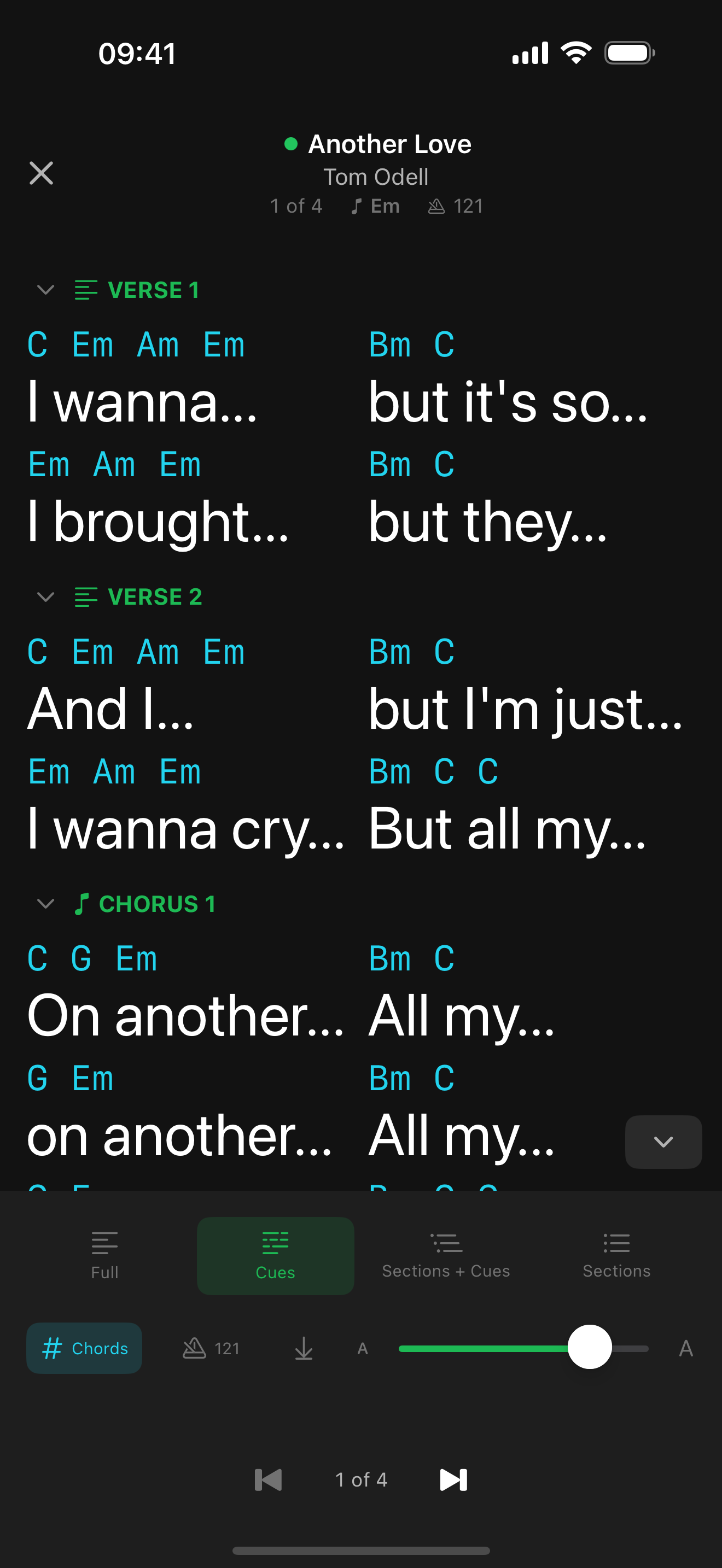
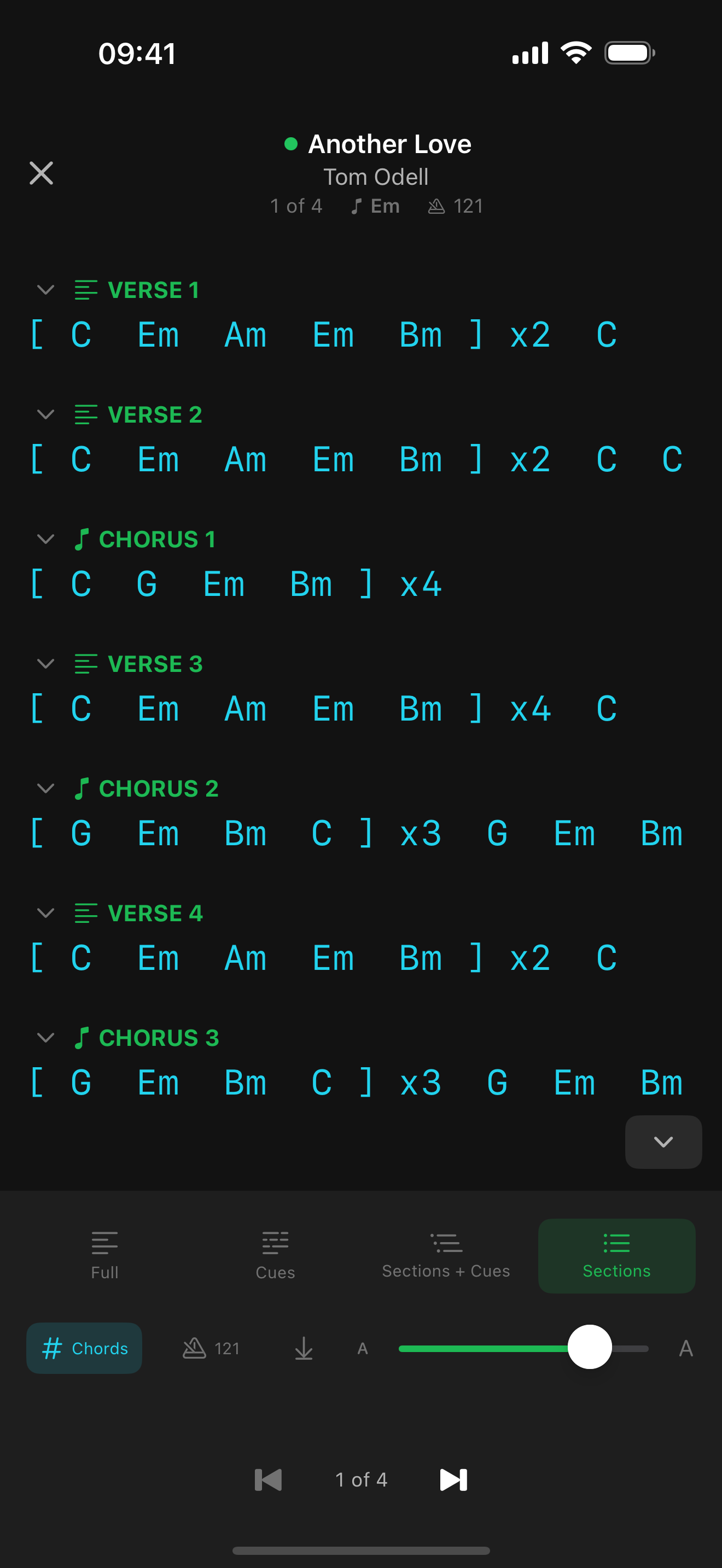
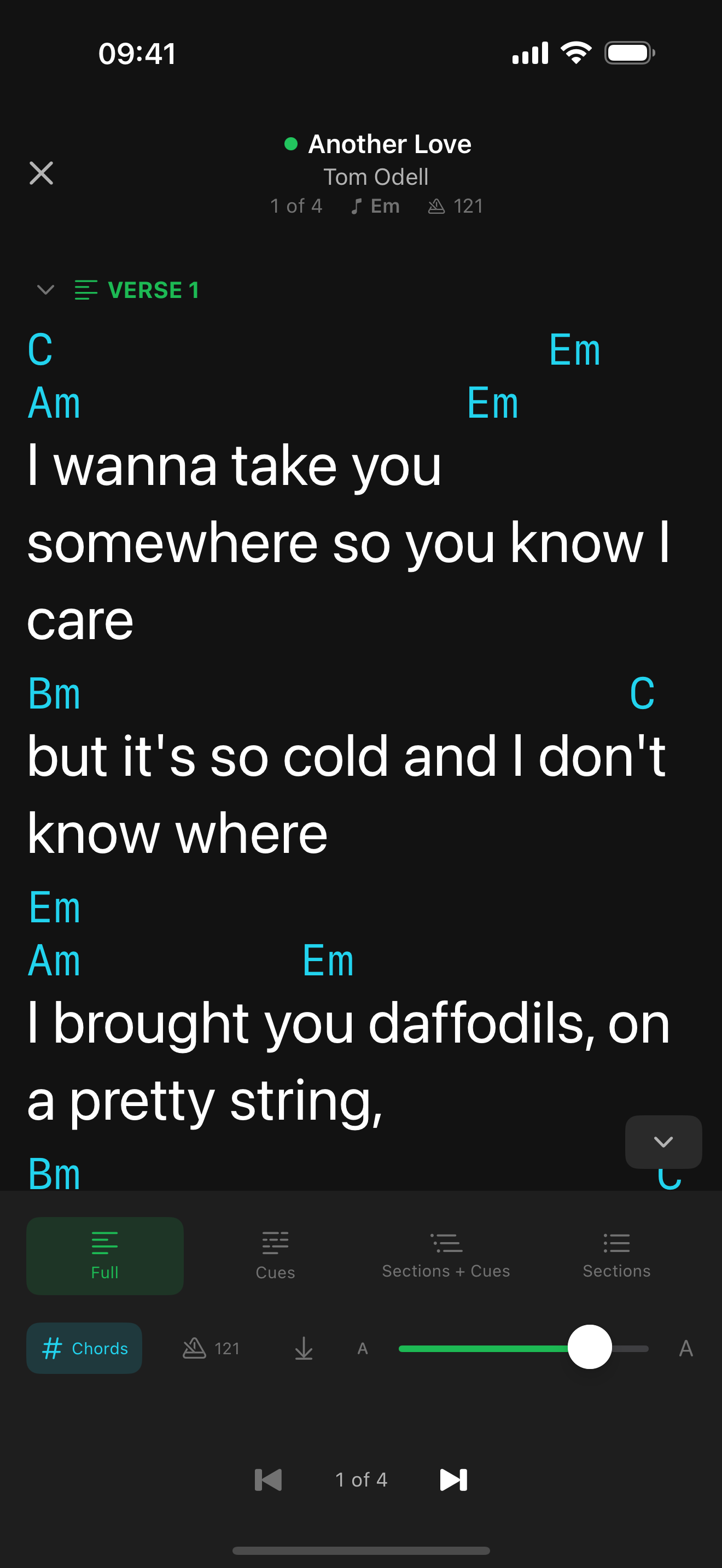
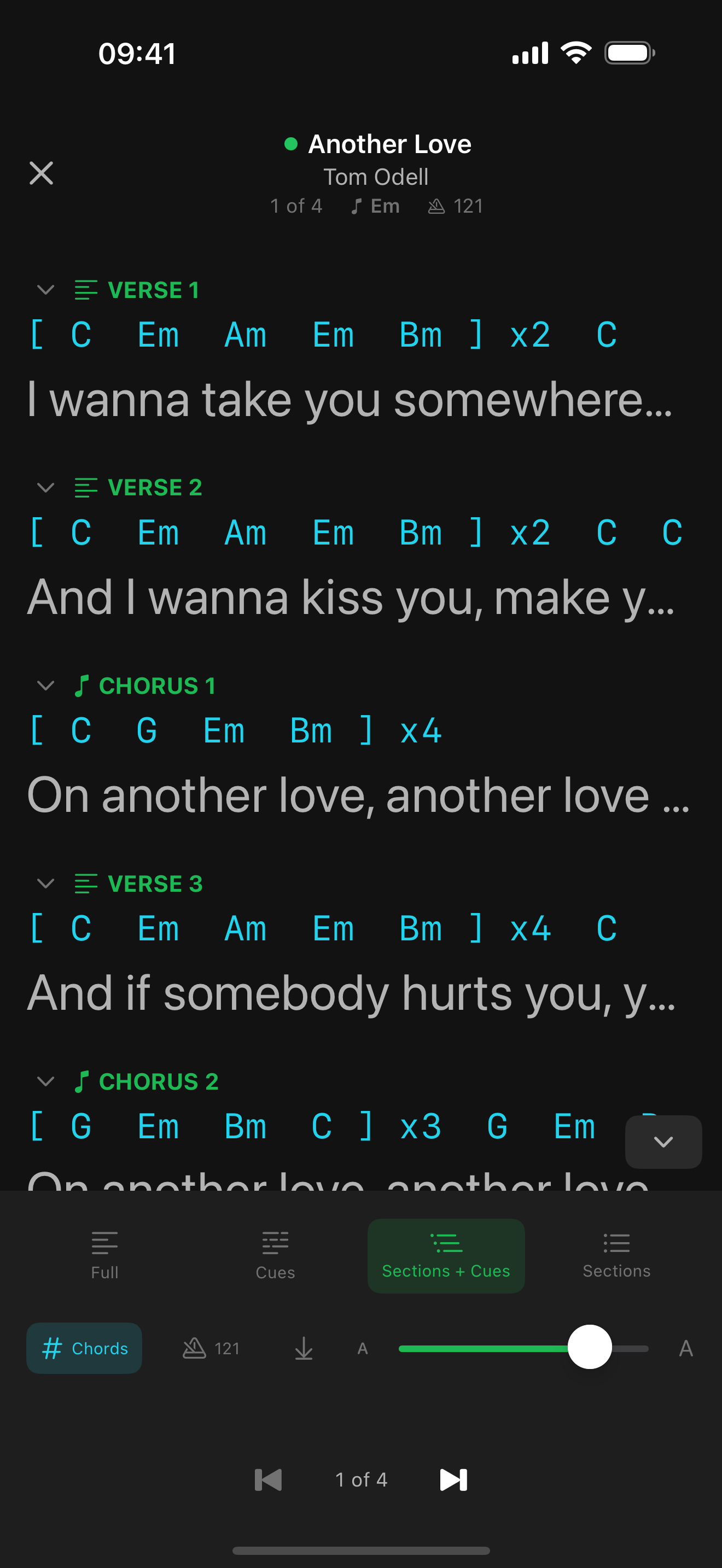
In practice, this means choosing how much you show. Full lyrics is available — but it's the maximum, not the default. The app also offers first-word cues for each line: just enough to unlock the next few words that you already know. Section headers: a structural map of where you are in the song, nothing more. These minimal displays force the brain to do the actual work of retrieval — they just remove the total blank, the terrifying nothing that causes panic.
Used correctly, cues mode barely requires a glance. You see "I never—" and the rest flows. Your eyes go back to the room. The connection stays intact. You were barely away.
But here's the real point: if you've done the practice, you won't need even the cues. They're there. But the work has already been done. The safety net catches you — it doesn't carry you.
Making the safety net unnecessary
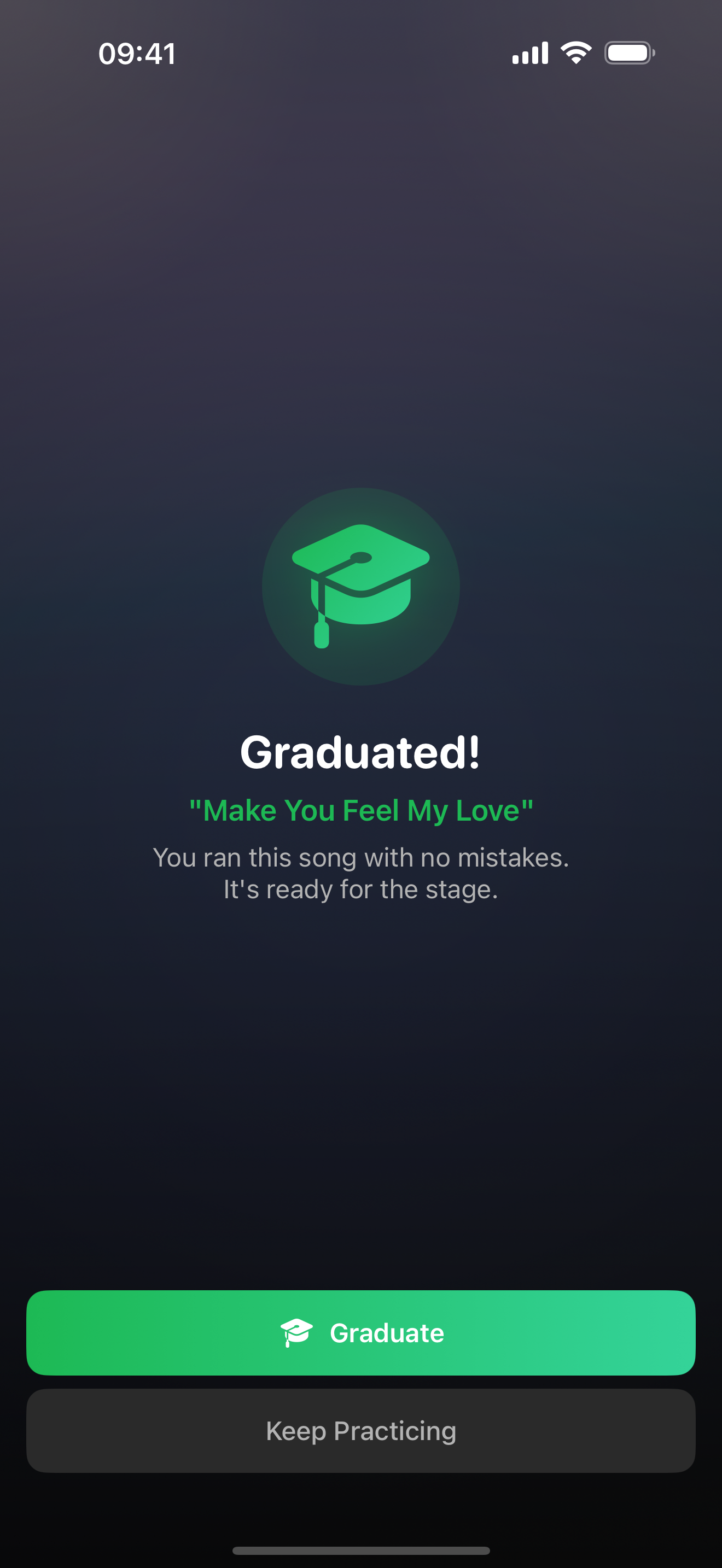
The practice side of Stage Proof exists for one reason: to make the Performance Mode unnecessary. Not useless — it's there, it's good, use it when you need it. But the goal is to practice until cues mode feels like overkill. To know a song well enough that the first-word prompt triggers nothing, because the line was already on its way.
That level of knowledge doesn't come from reading lyrics. It comes from being tested on them, repeatedly, at expanding intervals, on the lines you're actually weak on — not the chorus you've sung five hundred times, but the bridge in verse three you've always glossed over because the chorus was coming and you knew that one fine.
Active recall drills, spaced repetition, four different exercise formats that force retrieval at different levels of specificity — Stage Proof's practice engine is built to develop the kind of memory that doesn't stutter under stage nerves. The kind that comes back even when your hands are cold and the monitor mix is wrong and someone in the front row is filming you on their phone.
The kind that lets you look at the room.
Because that's what an audience came for. Not to watch you navigate a screen. To be looked at by someone who knows what they're doing and means every word they're singing. That's the connection that makes a performance feel like something. And it's the only thing a safety net can never provide.
Ready to put the phone away?

References
- Kendon, A. (1967). Some functions of gaze-direction in social interaction. Acta Psychologica, 26, 22–63.
- Frischen, A., Bayliss, A. P., & Tipper, S. P. (2007). Gaze cueing of attention: Visual attention, social cognition, and individual differences. Psychological Bulletin, 133(4), 694–724.
- Csikszentmihalyi, M. (1990). Flow: The Psychology of Optimal Experience. Harper & Row.
- Sparrow, B., Liu, J., & Wegner, D. M. (2011). Google effects on memory: Cognitive consequences of having information at our fingertips. Science, 333(6043), 776–778.
- Bandura, A. (1997). Self-Efficacy: The Exercise of Control. W. H. Freeman. See also: Kenny, D. T. (2011). The Psychology of Music Performance Anxiety. Oxford University Press.