The Gigging Musician's Setlist Strategy: How Many Songs, How Often, How Ready
Most working musicians have more songs in their library than they can honestly perform. The question isn't how many you've learned — it's how many you can confidently pull out tonight.
Ask a gigging musician how many songs they know and you'll usually get a number somewhere between "loads" and an embarrassed pause. Ask how many they could perform cold, right now, no warm-up — and the number drops fast. That gap between the total library and the live-ready subset is where most pre-gig anxiety lives. Managing it well is a skill in itself, and it's one most musicians never get a framework for.
This article is that framework. It covers how large your active repertoire actually needs to be, how quickly songs decay when you stop touching them, how to categorise your library honestly, and how to build a rotation strategy that keeps you performance-ready without burning all your practice time on songs you already know.
How many songs does a working musician actually need?
Research on expert musicians suggests a long-term repertoire of somewhere between 100 and 200 songs for active professionals — the accumulated range of a working career. But that figure is misleading as a target for any given gig. Studies of jazz musicians and session players consistently show that the realistic pull for a single two-set gig is 40 to 60 songs, and the practical sweet spot for a covers or function band with a rotating setlist is roughly the same. Most venues won't book you for more than two 45-minute sets, and two sets at 3–4 minutes per song tops out around 20–25 tracks.
So why maintain 40–60 instead of just 25? A few reasons:
- Audience requests. At weddings, parties, and open-ended bookings, the moment you play something people recognise, they start asking for more. Having depth means you can say yes instead of pivoting to the same three songs.
- Reading the room. A setlist planned on Tuesday might be wrong for the actual crowd on Saturday. You need enough material to change direction mid-show.
- Backup redundancy. Songs go wrong. A key that doesn't sit right that night, a tempo that doesn't fit the room's energy, a guest vocalist who knows a different version — you need options.
- Repeat bookings. If a venue books you twice in three months, you can't play the same 20 songs both times.
The practical rule of thumb: maintain at least 2× the songs you need for one gig in a genuinely performance-ready state, and keep another 1–2× in a "warm" state that needs a single focused session to bring back up. For most gigging musicians, that means an active repertoire of roughly 40–60 songs, with a wider library of 80–120 that you know at varying levels of readiness.
The decay problem: songs you don't touch start to slip
Memory doesn't stay where you put it. Psychologists have documented this since Ebbinghaus in the 1880s — without reinforcement, even well-learned material degrades over time. For musicians, this plays out in a very specific way: the song that felt totally solid three weeks ago now has one section that's a little soft, and you won't know which section until you're on stage and suddenly it isn't there.
The rough rule of thumb most experienced musicians arrive at independently: songs you haven't actively recalled in three weeks start to slip. Not fall apart — but the word-for-word precision at the line level, the confidence that the bridge just flows out of you without thinking, starts to erode. After six weeks without a touch, you're looking at a song that needs real work before it's gig-ready again. After three months, treat it like a song you're learning fresh.
This decay isn't uniform. Chorus lines survive longest — you've sung them hundreds of times, the repetition is built into the song's structure. Verse two, the bridge, the third stanza of a long ballad — these are where blanks happen. And the decay is invisible until the moment of retrieval under pressure. A song can feel fine in your head at home and fail completely on stage, because the cue conditions are different and the neural pathway is weaker than you thought.
The implication is that maintenance isn't optional. A song doesn't stay ready on its own. Every song in your active repertoire needs to be touched with active recall at some minimum interval — roughly every two to three weeks — to stay reliable. That sounds like a lot, but with the right system it's far less work than it sounds.
Four honest categories for your repertoire
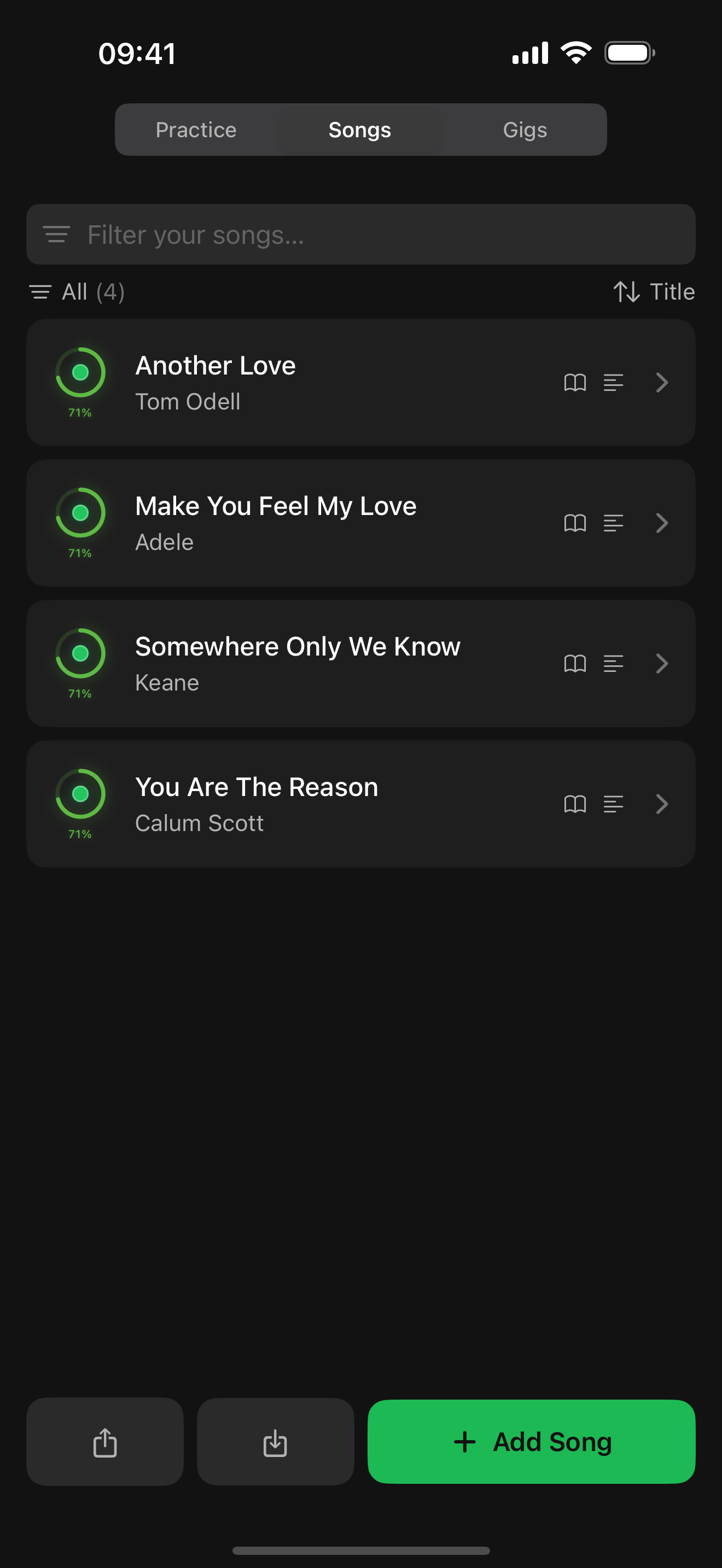
The first step to managing your library is having an accurate picture of where each song actually stands. Not where it stood six months ago when you really worked on it — where it stands now. Most musicians either have no system for this (gut feel only, which systematically overestimates readiness) or use a binary (know it / don't know it) that isn't granular enough to be useful.
A four-level system works better. Stage Proof uses exactly this — Unassessed, Needs Work, Getting There, and Stage Ready — and the labels are worth internalising as a mental model:
- Stage Ready. You can perform this song cold, right now, without a warm-up or cheat sheet. Every section flows. You're not reconstructing it in real time — it's retrieval, not reconstruction. This is the only category that belongs on tonight's setlist without a safety net.
- Getting There. You know the song well, but there's a section or two where you still hesitate, or where you need the first-word cue to fire the rest. One focused session will bring it up. Safe for a gig with Performance Mode visible, not safe cold.
- Needs Work. You know it exists in your library and you've worked on it, but you wouldn't trust it on stage without full lyrics in front of you. Two or three practice sessions away from Getting There.
- Unassessed. You've added it to the library but haven't drilled it enough to have a real sense of where it stands. Treat as not ready until proven otherwise.
Be honest here. The most dangerous category is the song you've mentally filed as Stage Ready based on how well it went six weeks ago, when in reality it's quietly slipped to Getting There. Those are the ones that cost you on stage.

Rotation strategy: keeping songs warm without burning out
Once you have an honest categorisation, you need a rotation — a structured approach to which songs get practice time and when, so that nothing important silently decays while you're focused elsewhere.
A practical rotation has three tiers:
Tier 1 — Active learning (10–20% of your library at any time). These are songs you're actively moving up the readiness ladder — Unassessed or Needs Work songs getting regular, focused practice sessions. Full active recall, all sections, flagging problem lines. You're not just running through these; you're testing yourself. Aim to graduate one song from this tier every week or two.
Tier 2 — Maintenance (your Stage Ready and Getting There core). These are your 40–60 active repertoire songs. They need a touch every two to three weeks to stay reliable. This doesn't have to be a full session — a 10-minute run through the hardest sections with active recall is enough to reset the decay clock. The key is consistency: brief and frequent beats long and occasional.
Tier 3 — Archive (temporarily retired). Songs that aren't in current rotation but aren't gone forever. You might retire a song because you've played it at the last three gigs and need a break from it, or because it's too seasonally specific, or because you just need to reduce the maintenance load right now. Archive doesn't mean forget — it means accept that you'll need a real prep session to revive it before a gig.
The rotation rule: every song in Tier 2 should be touched with active recall at least once every three weeks. If your active repertoire is 50 songs, that's roughly 17 songs per week to maintain — but at 10 minutes each for a maintenance session, that's under three hours a week spread across seven days. Manageable.
When to retire a song temporarily
Not every song needs to be Stage Ready all the time. Permanently maintaining 60 songs at full readiness is exhausting and unnecessary. Retire a song to the archive tier when:
- You've played it at three or more consecutive gigs and want to rest it.
- It's seasonally specific and the season is six months away.
- Your current booking schedule doesn't require it and you're overloaded with learning new material.
- You're planning to significantly rearrange it — retire the old version while you build the new one.
Retire a song intentionally, not by neglect. If you let it drift from Stage Ready to Getting There to Needs Work over three months without noticing, you've lost it without the benefit of having reduced your maintenance load on purpose. Mark it archived, stop the maintenance clock, and make a note of when you plan to revive it — ideally at least four weeks before the next gig it's likely to appear in.
Prepping for a specific gig vs. maintaining general readiness
These are two different problems and they need different strategies.
General readiness is the baseline practice described above — the rotation that keeps your active repertoire at Stage Ready or Getting There across the board. This is what you do between gigs, as a habit. It's not glamorous, but it's what prevents the pre-gig panic.
Gig-specific prep is what you do in the two weeks before a particular booking. Once you have the setlist confirmed (or a reasonable draft), your job is:
- Audit every song on the setlist against its current readiness rating. Not from memory — actually check. Songs you haven't touched in three weeks should be treated as Getting There until you've verified otherwise.
- Prioritise the weakest songs first. Don't spend your prep time polishing Stage Ready songs because it feels productive. The songs that are Going There or Needs Work need the most attention and they'll repay it the most.
- Do at least one full run-through of each song in performance conditions — meaning no safety net, no quick peek at the lyrics, just the music and your recall. This surfaces the lines you think you know but don't.
- Set your performance safety net. For any song that isn't fully Stage Ready, decide in advance what your live safety net is: first-word cues only, section headers, or full lyrics visible but minimised. Have the configuration ready before you walk on stage, not while you're on it.
A useful rule of thumb for gig-specific prep: aim to have every song on your setlist at Stage Ready status at least 48 hours before the show. Not the morning of, not the evening before — 48 hours. This gives you time to do one final light run-through the day before and walk on stage with genuine confidence rather than last-minute cramming that decays before the first song ends.
The gig planner: connecting readiness to the actual show
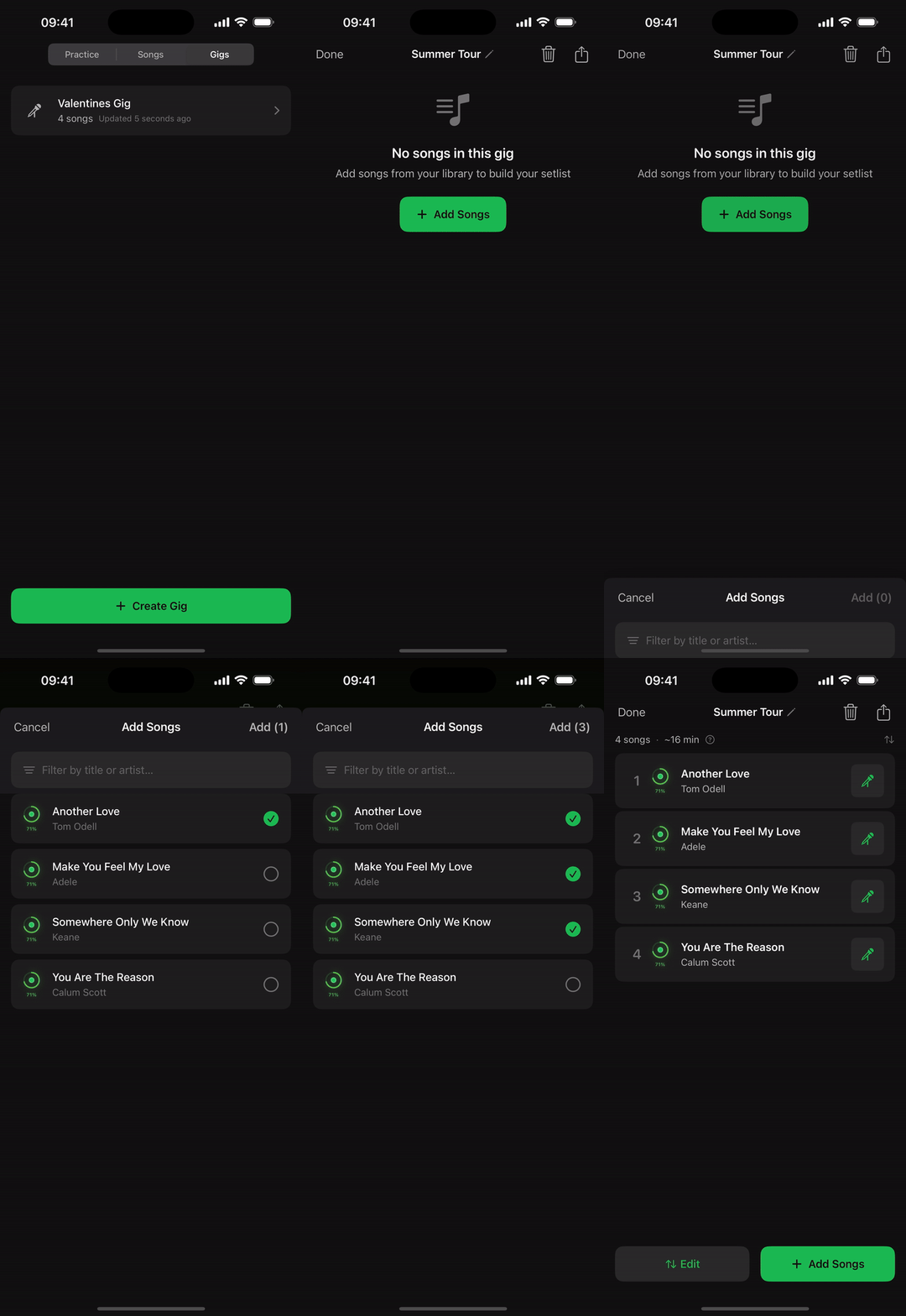
The weakness of most practice tools is that they treat songs in isolation — you learn them one by one without ever seeing the full picture of a setlist. Stage Proof's gig planner connects your readiness ratings directly to a specific show: you build the setlist, see at a glance which songs are Stage Ready and which ones need work before the date, and track your prep as a unit rather than as 20 disconnected practice sessions.
This matters more than it sounds. The goal isn't to know songs in the abstract — it's to be ready for a specific performance on a specific night. Having a gig in the calendar with a date and a setlist turns the readiness question from "generally, how well do I know this?" into "will this song be ready in 11 days?" Those are very different questions, and the second one is the one that actually drives good practice behaviour.
Practice mode as your readiness engine
The categorisation and rotation system above is only as good as the practice that feeds it. The most common maintenance mistake is passive practice — singing through the song with the lyrics visible, feeling like you know it, then moving on. That's not maintenance. That's keeping the song familiar, which is not the same as keeping it Stage Ready.
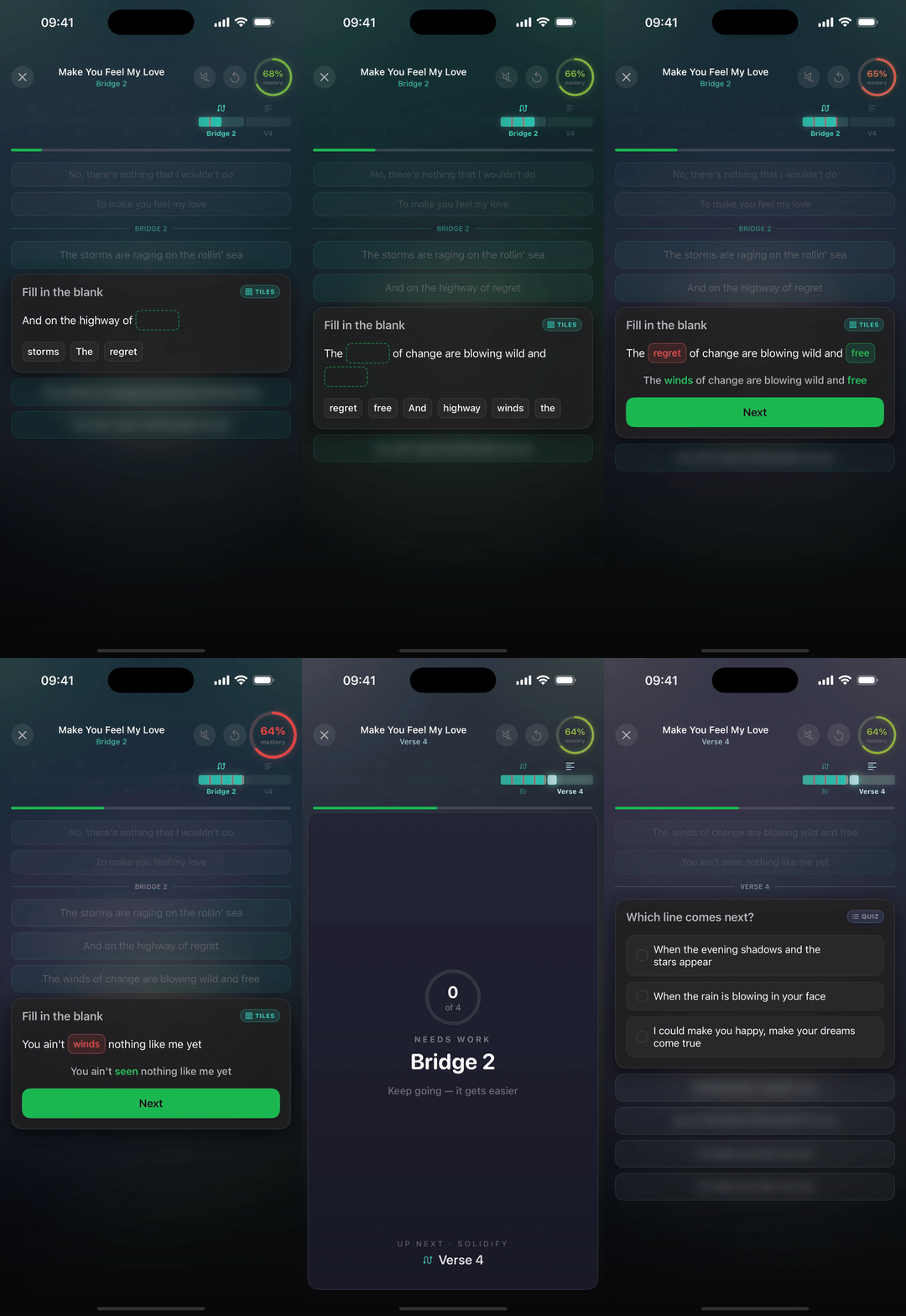
Effective maintenance practice is active recall: closing the lyrics, attempting to retrieve each line without a prompt, and honestly noting where you hesitate. Stage Proof's practice mode does this systematically — multiple choice, fill in the blank, sentence builder, and free recall — and tracks your accuracy at the line level so the weakest points get the most attention. A 10-minute active recall session on a song you know well will reveal exactly which two or three lines are quietly slipping, and fix them, in less time than a full passive run-through.
Putting it together: the working musician's routine
Here's how this looks as an actual weekly practice routine for a musician with 50 songs in active rotation and gigs every few weeks:
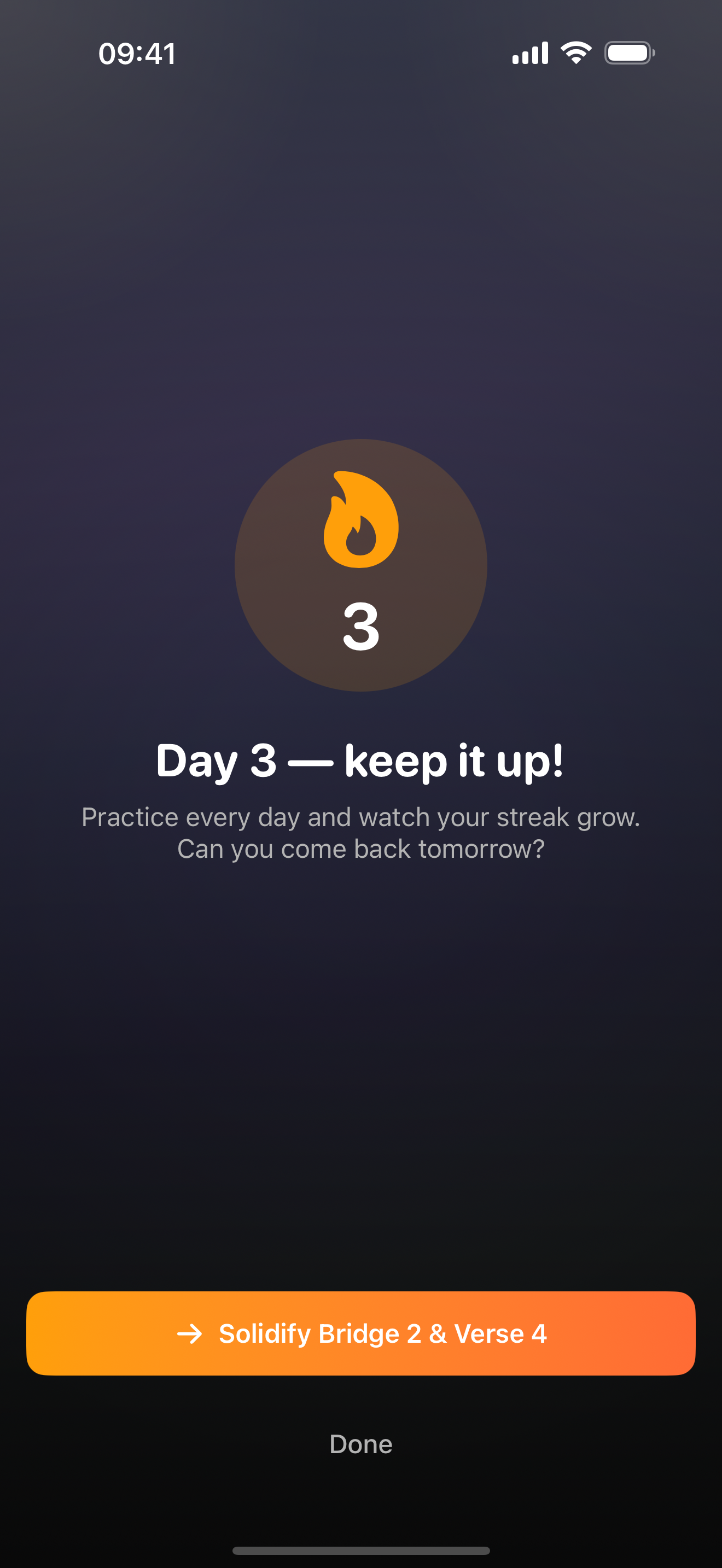
- Daily (10–15 min): One or two maintenance sessions on songs due for a touch, using active recall mode. Rotate through the library so everything gets hit every 2–3 weeks.
- Weekly (30 min): One focused learning session on a Needs Work or Unassessed song — full active recall, section by section, until problem lines are flagged and improving.
- Two weeks before a gig: Audit the setlist, prioritise Getting There songs for focused sessions, start logging readiness ratings against the specific show.
- 48 hours before a gig: All setlist songs should be Stage Ready. One final light run-through, set your performance safety nets, and stop cramming.
The most important shift is treating repertoire maintenance as ongoing hygiene rather than pre-gig panic. The musicians who arrive at every show genuinely ready aren't spending more total time practicing — they're spending it more consistently, earlier, with better focus. Short sessions, active recall, honest readiness ratings, and a system that tells you what to work on next. That's the whole thing.
Ready to keep your whole repertoire stage-ready?
