How Professional Actors Learn Lines — And What Musicians Can Steal From Them
An actor stepping onto a West End stage knows every word. Not because they read the script a hundred times — but because they stopped reading it as early as possible.
There's a discipline in professional acting that most musicians have never been exposed to: the deliberate, systematic process of learning text off-book. Actors have spent decades refining this — through formal methodology, peer coaching, and performance science — and what they've landed on runs directly counter to how most musicians approach lyric memorization. Understanding the difference could change the way you practice entirely.
What actors actually do
The first thing to understand is that experienced actors almost never learn lines by reading them. They learn lines by testing themselves on them. The standard professional practice is to get off-book as early as possible in rehearsal — ideally before the first read-through with the director — and then spend the entire rehearsal process running lines under conditions of increasing pressure.
Running lines means exactly what it sounds like: reciting the script from memory, with a partner reading opposite you, at full speed, without pauses to check. You go blank, you stay blank for a moment, you push through or you ask for a line, and then you keep going. It's uncomfortable in a way that reading the script never is. That discomfort is the point.
Alongside this, actors use a technique that Stanislavski formalized over a century ago and that modern acting pedagogy still considers foundational: learning the intention behind each line rather than the line itself.1 Instead of memorizing "I don't know what you mean" as a sequence of words, an actor learns it as an action — deflecting, protecting, denying — and the words follow naturally from that intention. The text becomes a consequence of knowing what the character wants in this moment.
Actors also chunk by scene and beat. A play is not learned as one continuous text from page one to page ninety. It's broken into beats — units of intention — and into scenes and subsections, each with its own emotional logic. A scene is mastered before the actor moves on to the next. The chunks are small enough to be drilled to fluency, and they accumulate in sequence rather than being attacked all at once.
Finally, many actors use physical anchoring: they learn lines while moving through the blocking, so that spatial memory becomes a retrieval cue. The physical position of standing by the window, crossing to the desk, turning to face upstage — each movement is associated with a specific piece of text. The body becomes part of the memory system.
The science behind the actor's method
Helga Noice and Tony Noice spent years studying actors as a model for human memory, and in 2006 they published a landmark paper in Psychological Science in the Public Interest that explained precisely why the actor's approach works so well.2
Their central finding was that professional actors do not rote-memorize their lines at all. They do not sit down and repeat words until they stick. Instead, they focus on understanding and embodying the motivation behind each utterance — and verbatim retention of the words is essentially a side effect of that process. When actors were given scripts and asked to learn them, those who focused on intention and action remembered significantly more of the actual text than those who tried to memorize the words directly.
The Noices also found that this "active experiencing" approach produced memory that was far more resistant to interference under pressure — exactly the kind of pressure that performers face. When you've encoded a line as a consequence of an intention, you can reconstruct it even under stress. When you've encoded it as a sequence of words, stress disrupts the sequence and the words fall apart.
This maps directly onto what cognitive psychologists call elaborative encoding: memories that are formed with rich contextual meaning are retrieved more easily and more reliably than memories formed through bare repetition.3 The actor's method is, at its core, a highly sophisticated form of elaborative encoding — one that happens to produce verbatim retention as a byproduct of deep comprehension.
The key difference: one text vs. fifty songs
Here's where the parallel gets interesting — and where musicians face a challenge that actors genuinely don't.
A professional actor preparing a role has one text. One set of lines, maybe ninety minutes of material. They spend weeks in intensive rehearsal, usually with dedicated line-learning partners and a director focused on the same material. The conditions are almost ideal for deep encoding: high repetition of a single, meaning-rich body of text, with constant external testing (rehearsal) and strong physical anchoring (blocking).
A working musician has fifty songs. Or a hundred. Each with three or four verses, a bridge, a pre-chorus. Many of the songs share similar phrasing and similar rhyme schemes, which means interference is high — the wrong verse from a similar song is a constant threat. And unlike actors, most musicians learn their songs largely alone, with the music playing, which creates a cue-dependency problem: the lyrics feel solid when the track is running, and fall apart the moment the track stops.
This is the musician's specific challenge: to build lyric memory that is scale-resistant, interference-resistant, and cue-independent. The actor's techniques point toward the solution. But they need to be adapted to work across a large and constantly evolving repertoire.
What musicians can steal: four techniques
1. Get off-book early — and test cold
The single most powerful thing actors do is stop looking at the script early. For musicians, the equivalent is practicing lyrics without the backing track, without the sheet, without singing along to the recording. Just the words, from memory, cold.
This is uncomfortable the first few times. That discomfort is not a sign that you don't know the song. It's a sign that your memory was cue-dependent — relying on the melody or the audio to trigger the text. Building cue-independent retrieval takes a few sessions of deliberate cold testing, but once it's there, the lyrics become genuinely yours. The music becomes a reinforcement of memory, not a crutch for it.
2. Chunk by section
Don't try to practice a song end-to-end until each section is solid on its own. Verse one first. When that's clean, verse two. When both are solid, run them together. Bridge last, because it's the most distinctive and usually the hardest to trigger.
This is exactly how actors work through scenes — and the reason it works is that chunking creates bounded retrieval targets. Rather than navigating a continuous flow of text where any blank can cascade into a longer blank, you're working with small, self-contained units that have clear beginnings and ends. Fluency builds section by section, and the accumulation feels manageable rather than overwhelming.
3. Learn the intention, not just the words
This is harder for musicians than it sounds, because song lyrics don't always have a clear narrative structure. But even in abstract or impressionistic lyrics, there is usually an emotional arc: defiance, longing, release, triumph. That arc is the musician's equivalent of the actor's intention — and connecting words to emotion is one of the most effective encoding strategies available.
Ask yourself: what is this line doing? Is it escalating tension? Offering resolution? Turning the story? Even a rough answer is better than treating the words as a neutral sequence to be memorized. Emotion-linked memories are encoded more strongly and retrieved more easily than neutral ones — this is one of the most replicated findings in memory science.4
4. Space your practice, don't cram it
Actors run lines in short, frequent sessions throughout a rehearsal period — not in one long cram the night before. The Ebbinghaus forgetting curve applies to performers as much as to students: without spaced reinforcement, material decays. The solution is to practice a little, frequently, over a long enough window that each session catches the material just as it starts to fade.
For a musician with a large repertoire, this means spreading practice across songs rather than drilling one song to exhaustion. Songs you know well need only a brief brush-up. Songs you've recently learned need more frequent visits. And songs you haven't touched in a month may need to be treated almost as new material.
How Stage Proof translates this into practice
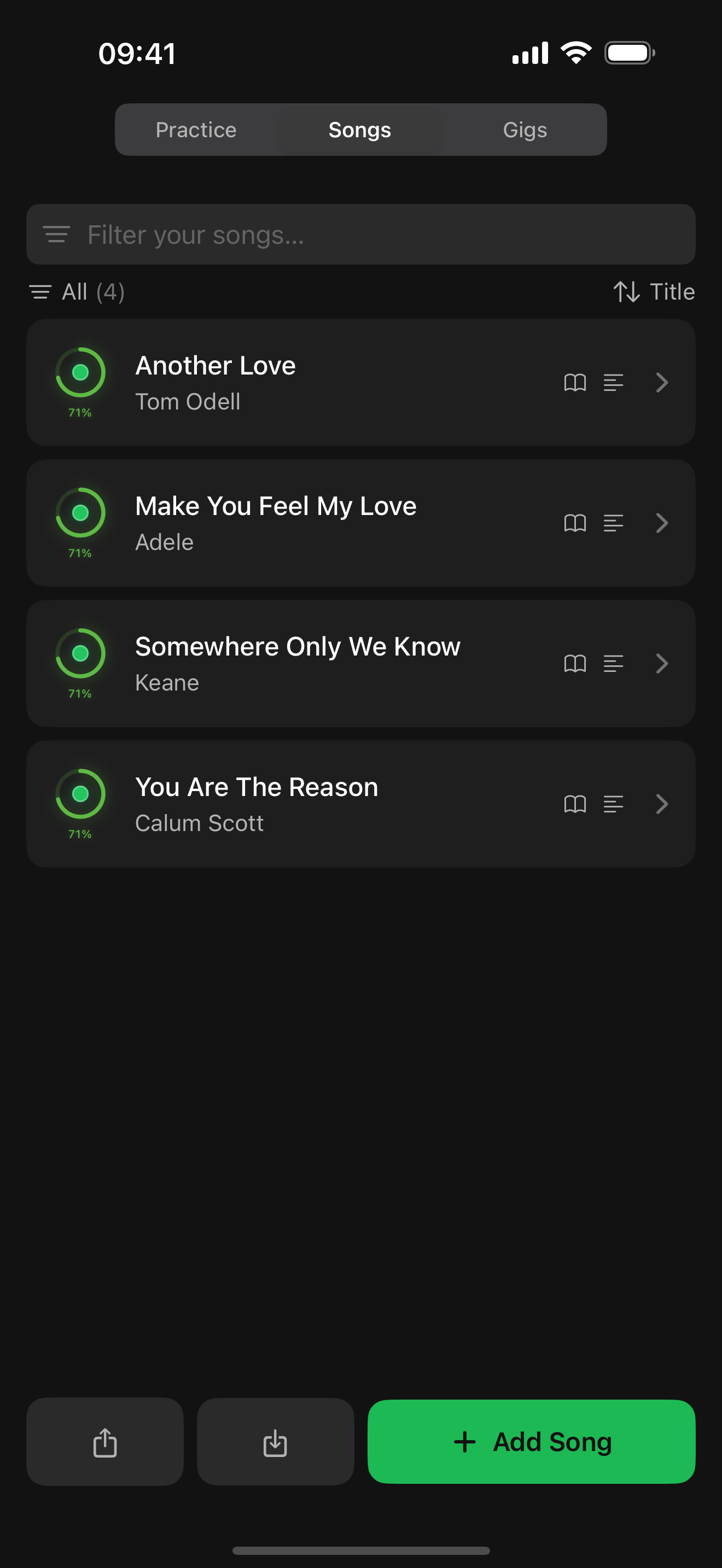
Stage Proof is built around the same principles that make actor line-learning work — adapted for the specific challenge of a large, evolving musical repertoire.
The free recall exercise is the direct equivalent of running lines cold. The app shows you a cue — the preceding line, or the section header — and asks you to produce the next line from memory, without options, without scaffolding. You attempt it, reveal the answer, and rate yourself honestly. This is the most uncomfortable exercise in the app, and the most powerful one.
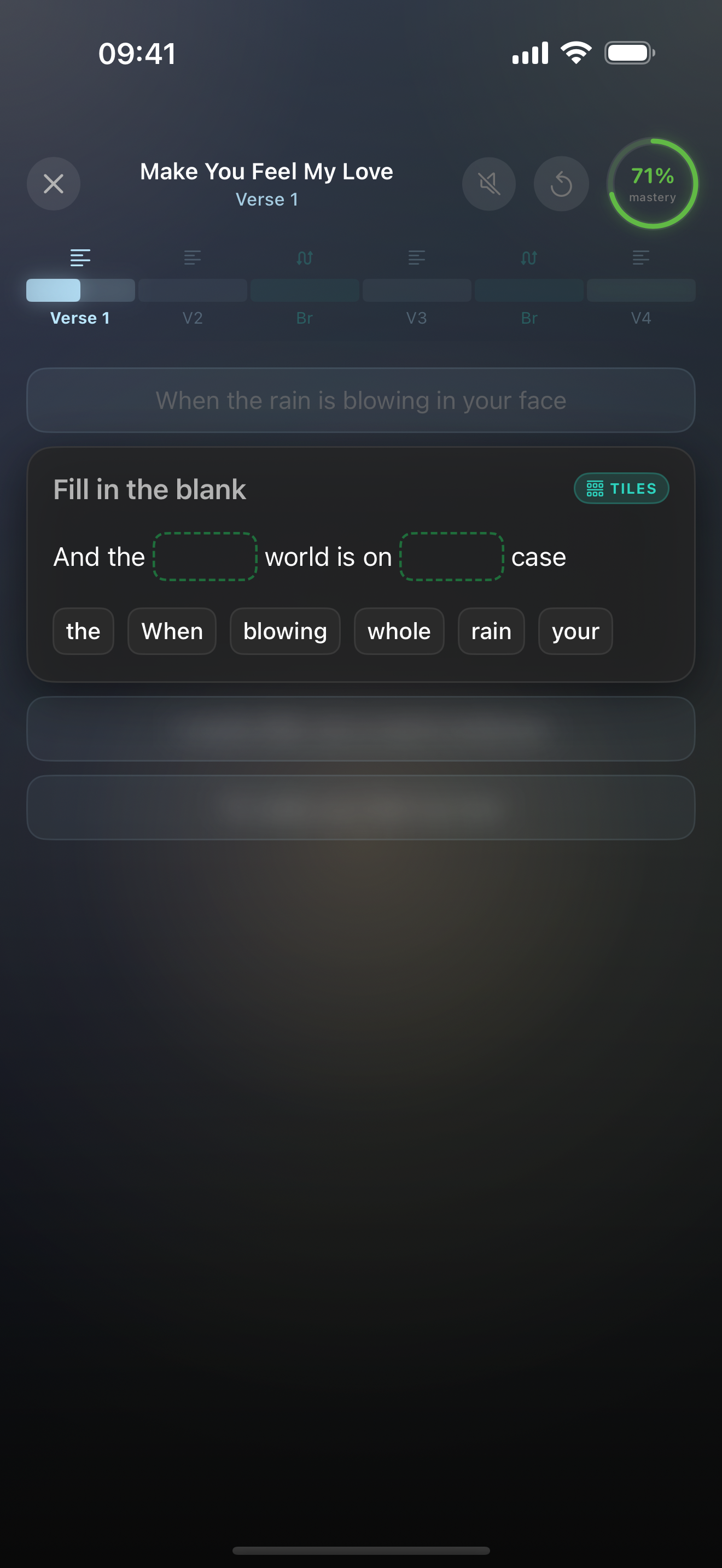
The sentence builder exercise is the chunking technique in digital form. Rather than testing the full section at once, the app isolates a single line and asks you to reconstruct it word by word from shuffled tiles. The precision required maps directly onto the actor's work of drilling a single beat until it's absolutely clean before moving on.
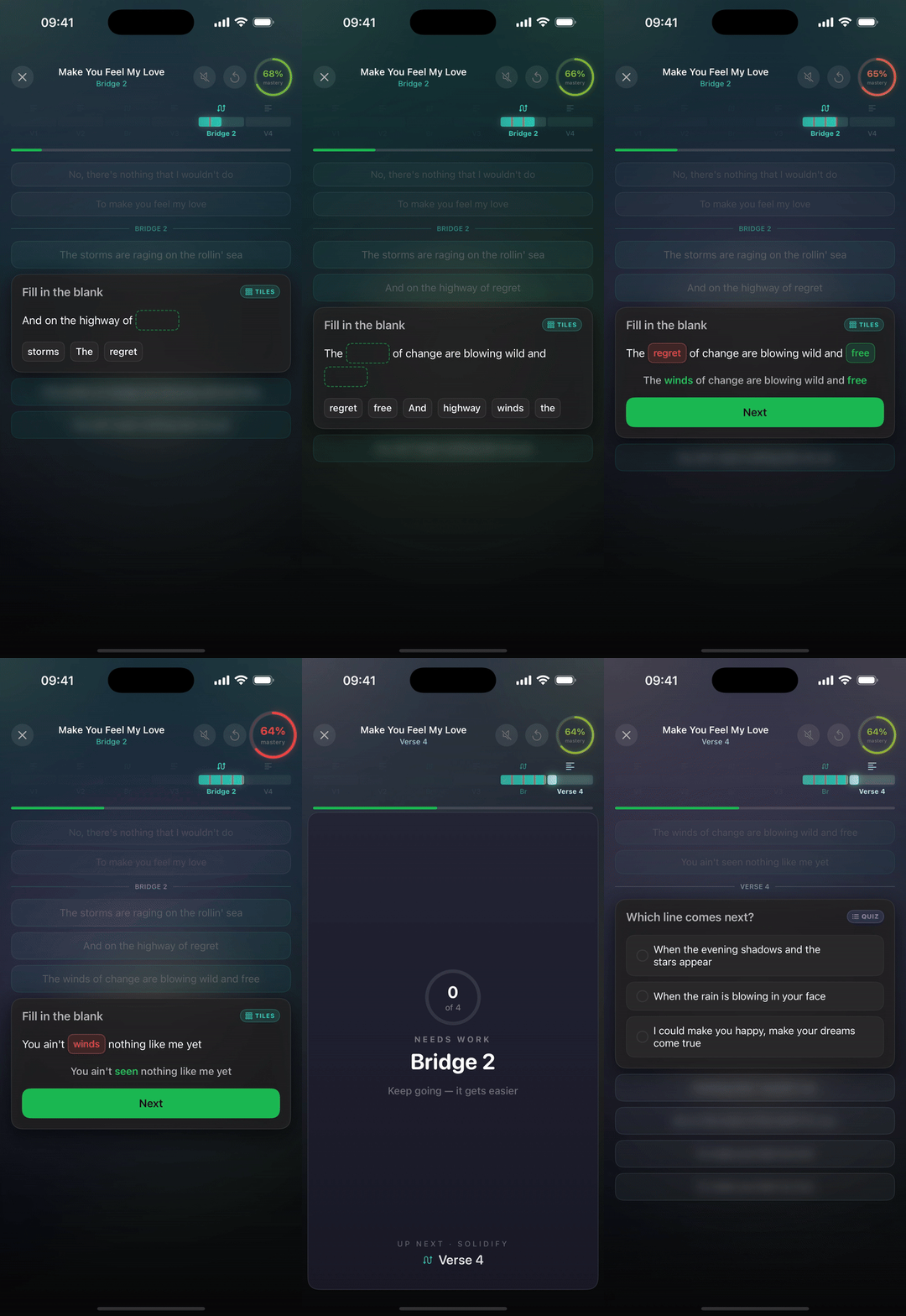
Multiple choice mirrors the kind of interference-management that actors develop when they rehearse similar scenes back-to-back — training the brain not just to recall the right line but to actively reject the wrong ones. For musicians with large repertoires, where similar phrases appear in multiple songs, this is more important than it might seem.
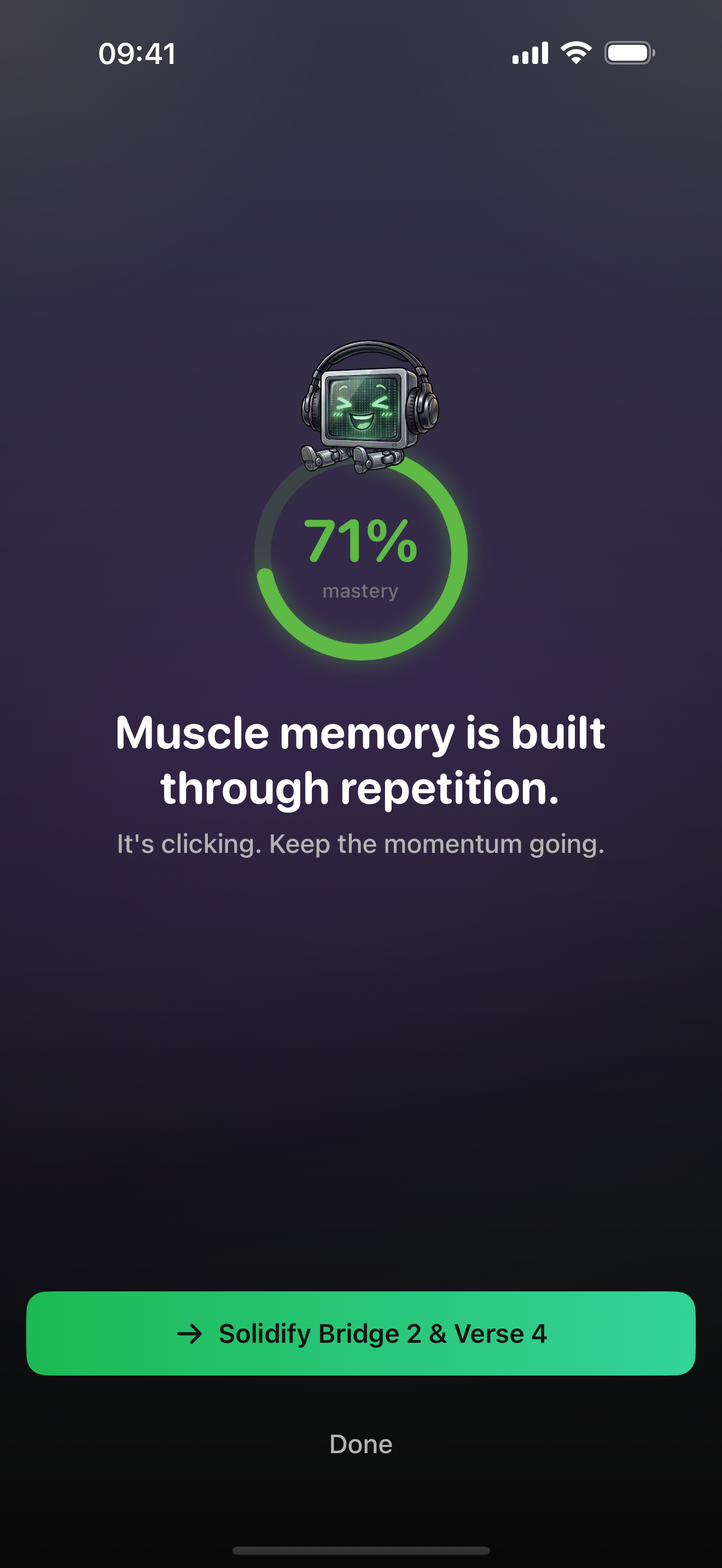
And the practice system tracks mistakes at the individual line and section level, then automatically focuses the next session on the weakest areas — starting from the section with the lowest mastery score and surfacing the lines that have tripped you up most. Lines you find difficult come back more. Sections you've mastered get less attention. The result is that your practice time concentrates on the lines most at risk of failing — the verse three bridges and second-chorus variants that actors would call "the dangerous bits."

The deepest parallel
What the Noices found about actors, and what performance science keeps confirming, is a principle that applies equally to any domain where material must be produced fluently under pressure: the way you practice must resemble the conditions of performance.
Actors don't prepare for performance by reading their scripts. They prepare by performing — in rehearsal, in line-runs, in walkthroughs — under conditions that approximate the demands of the actual stage. The discomfort of being tested, of going blank and recovering, of producing text without a safety net, is not an unfortunate side effect of rehearsal. It is the mechanism of learning.
Musicians who run through their songs with the track playing, singing along, checking the sheet when they get stuck — they are not rehearsing for performance. They are rehearsing for a very comfortable version of being at home with a screen. The conditions are wrong. The learning that results is fragile.
The fix is the same one actors discovered a hundred years ago: test yourself constantly, strip the cues early, chunk and drill, and trust that discomfort in practice is what makes confidence in performance possible.
Ready to practice the way actors do?

References
- Stanislavski, K. (1936). An Actor Prepares. Theatre Arts Books. (English translation by Elizabeth Reynolds Hapgood.)
- Noice, H., & Noice, T. (2006). What studies of actors and acting can teach us about memory and cognitive functioning. Psychological Science in the Public Interest, 7(1), 14–41.
- Craik, F. I. M., & Lockhart, R. S. (1972). Levels of processing: A framework for memory research. Journal of Verbal Learning and Verbal Behavior, 11(6), 671–684.
- Cahill, L., & McGaugh, J. L. (1995). A novel demonstration of enhanced memory associated with emotional arousal. Consciousness and Cognition, 4(4), 410–421.