The Science of Learning Lyrics: Why Stage Proof Works
Reading your lyrics the night before a gig is not practice. It is an illusion of practice — and cognitive science has known this for over a century.
Every musician who has stood under a spotlight and felt verse two dissolve into static knows the gap between familiarity and fluency. You've read the words dozens of times. You know the melody. And yet, the moment the nerves arrive, the words are simply gone. The problem isn't laziness or bad memory — it's the wrong learning method. Stage Proof is built around the methods that actually work. Here's the research behind them.
The forgetting curve and why re-reading fails
In 1885, German psychologist Hermann Ebbinghaus documented one of the most replicated findings in memory research: without active reinforcement, we forget roughly 70% of newly learned material within 24 hours, and close to 90% within a week.1 The curve is steep and merciless.
The intuitive response — "then I'll just read it again" — is precisely the trap. Passive re-reading produces a sense of familiarity that the brain misinterprets as learning. Psychologists call this the fluency illusion: repeated exposure to material feels like mastery, but it builds recognition, not retrieval.2 Recognition tells you "yes, that's right" when you see the correct answer. Retrieval is what lets you produce the answer yourself, under pressure, on stage.
Key finding: In a landmark study by Roediger & Karpicke (2006), students who studied material once and then were tested recalled 61% of it a week later. Students who spent the same time re-reading it recalled just 40%.3 Testing beats re-reading by a factor of 1.5x — even when the tests were not graded and no feedback was given.
Active recall: testing yourself is the practice
The most robust finding in the science of learning is called the testing effect (also called retrieval practice): the act of trying to remember something strengthens the memory far more than passively reviewing it.3,4 Every time the brain is forced to retrieve a memory, it reinforces the neural pathway used to access it — making that pathway faster, more reliable, and more resistant to interference under stress.
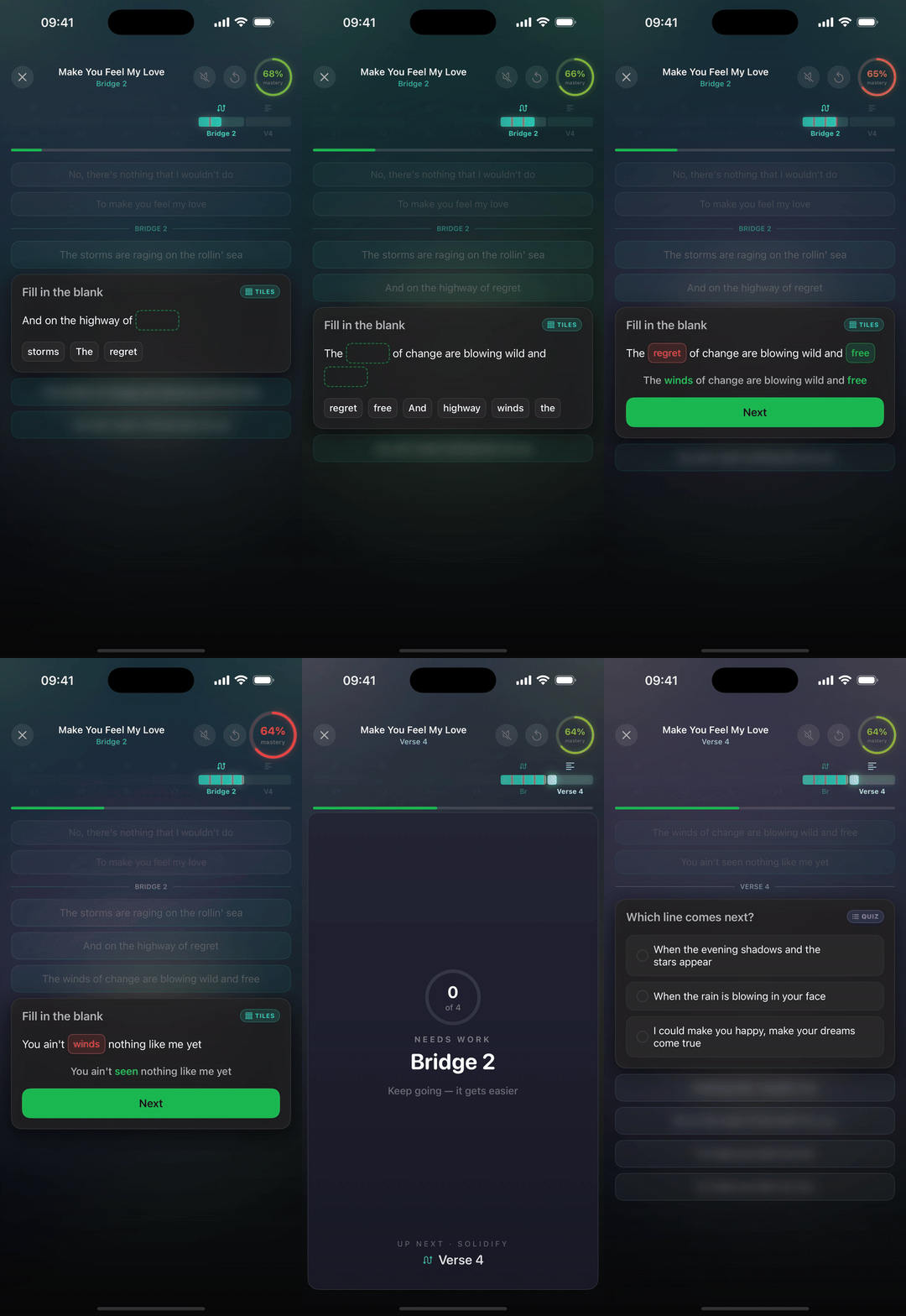
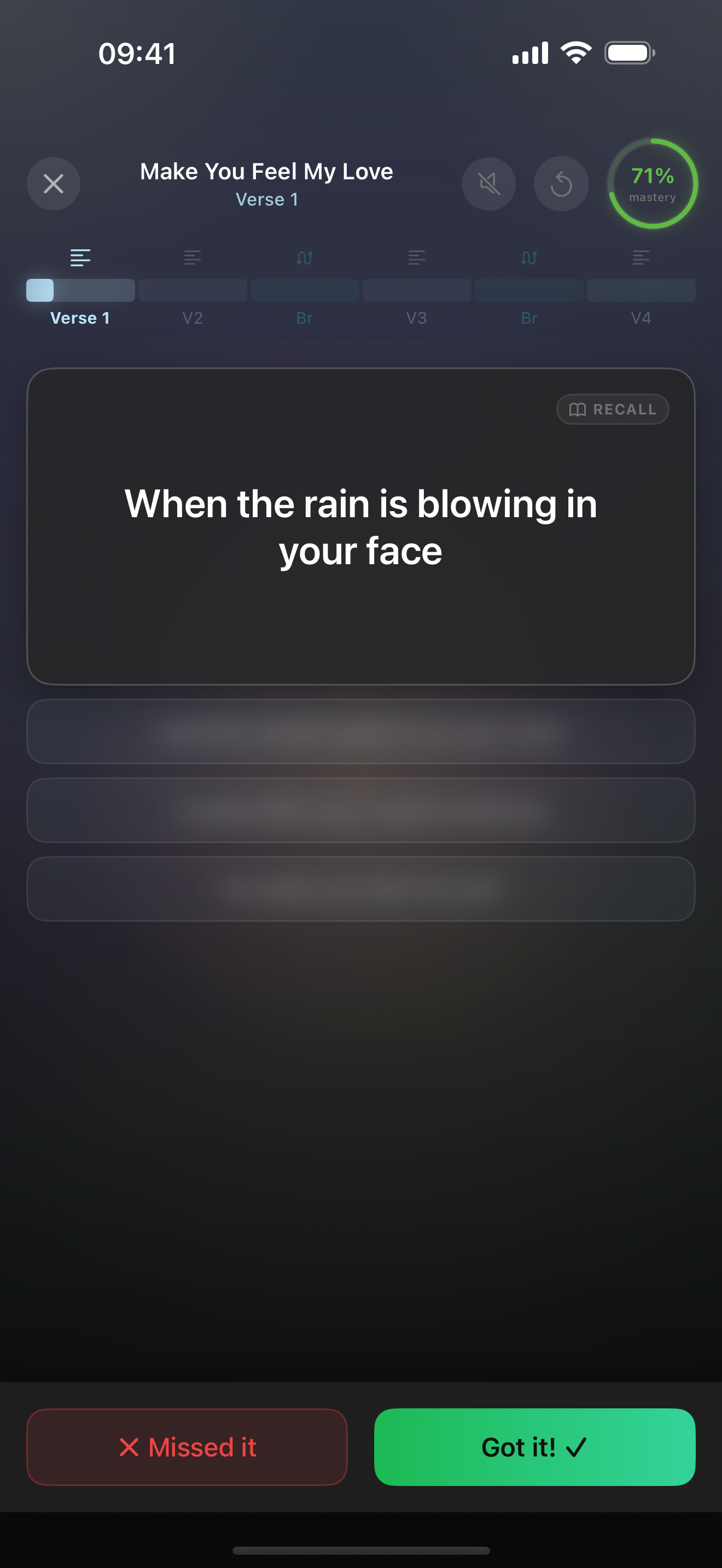
This is exactly how Stage Proof's Practice Mode works. Rather than showing you the lyrics so you can read along, the app asks you to retrieve them — through four distinct exercise formats:
- Free recall — see the cue line, attempt the next line from memory, then reveal and self-rate.
- Multiple choice — identify the correct next line from a set of plausible alternatives.
- Fill in the blank — type or select the missing word from within a line.
- Sentence builder — reconstruct a line from shuffled word tiles in the right order.
Each of these formats forces retrieval at a different level of specificity. Sentence builder, for example, targets exact word order — the kind of precision that matters when a melody locks you into a rhythm that can't be paraphrased. Multiple choice trains pattern recognition under conditions closer to the real performance context, where a wrong word might feel "close enough" and needs to be actively rejected.
Spaced repetition: drilling the lines you actually need
Not all lines in a song are equally hard. Chorus lines are drilled hundreds of times by the music itself; bridge lines in verse three are exposed far less often, and that's exactly where blanks happen on stage. A practice system that treats every line identically is wasting most of your time.
Stage Proof tracks performance at the individual line level and applies a spaced repetition algorithm modeled after the SM-2 framework used in language learning applications like Anki and Duolingo.5 Lines you answer correctly move to longer review intervals. Lines you miss or rate poorly get scheduled for re-testing sooner — sometimes within the same session. The result is an adaptive queue that automatically concentrates your effort on the weakest points in your repertoire.
Key finding: Cepeda et al. (2006) conducted a meta-analysis of 254 studies on distributed practice and concluded that spacing study sessions over time produces "dramatically better" long-term retention than massed practice — with optimal spacing producing up to a 64% improvement in retention at a two-week delay.6
The practical effect for musicians is significant: instead of drilling a 16-verse setlist uniformly for an hour, Stage Proof compresses that effort into the lines that are genuinely at risk of failing. A typical practice session surfaces roughly 3–5 difficult lines per song — exactly the ones that would have cost you the performance.
Interleaving: why mixing exercises accelerates learning
Stage Proof doesn't lock you into a single exercise format per session. The app interleaves different question types across the same set of lines — which turns out to be critical. Research on interleaving (also called mixed practice) shows that alternating between problem types during learning produces better long-term retention than blocked practice (doing all of one type, then all of another), even though blocked practice feels more comfortable and productive at the time.7
The mechanism is discriminative contrast: when the exercise format changes, the brain must not only retrieve the answer but also identify which retrieval strategy applies to this particular prompt. This additional cognitive work — which feels like difficulty — is actually what drives deeper encoding. In educational psychology this is called desirable difficulty.8
Gamification: the motivation layer science supports
Cognitive techniques are necessary but not sufficient. The most effective learning system in the world is useless if you don't open the app. Motivation is the real bottleneck — and this is where gamification enters.
A 2014 meta-analysis by Hamari et al. examined 24 empirical studies on gamification and found that game-like elements (progress feedback, streaks, achievement markers) consistently produced positive effects on engagement and learning motivation, particularly when users felt a sense of competence and autonomy.9 This maps directly onto self-determination theory (Deci & Ryan, 1985), which identifies competence, autonomy, and relatedness as the three core human needs that sustain intrinsic motivation.10
Stage Proof is built around these principles:
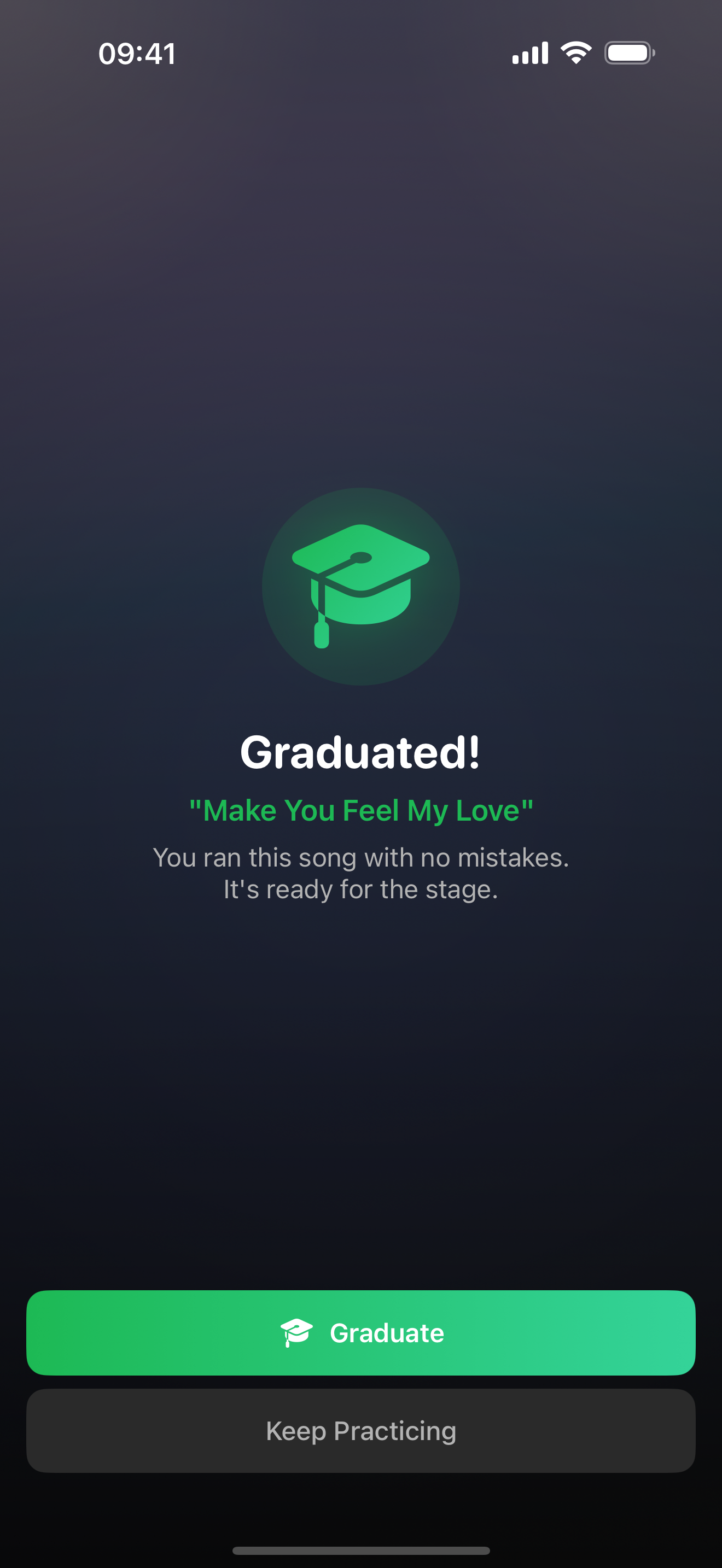
- Competence — A per-song readiness score gives you concrete evidence that your practice is working. Songs graduate once you've truly learned them, providing a clear milestone that feels earned.
- Autonomy — You choose which song to practice, which mode to use, and how long a session runs. The algorithm is advisory, not prescriptive.
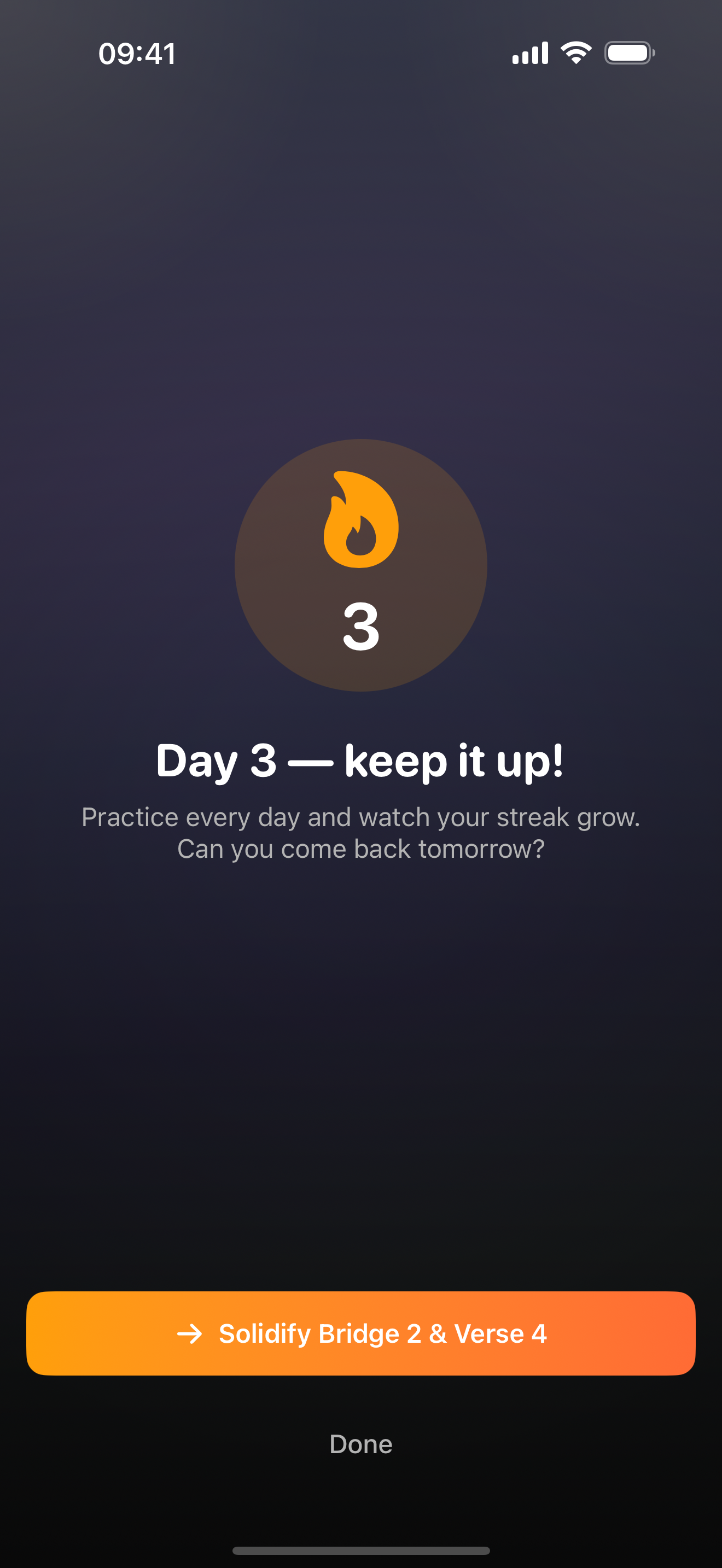
- Progress feedback — Streaks, session summaries, and per-line accuracy history close the feedback loop that keeps motivation alive across days and weeks.
Music, emotion, and memory: a special case
Lyrics are not arbitrary text. They live inside a musical structure — rhythm, melody, rhyme, and emotional context — that the brain processes through overlapping but partially distinct systems from those used for plain verbal memory.11 This has an important implication: song lyrics are easier to encode (music provides scaffolding) but harder to retrieve on demand in isolation, precisely because retrieval is partially cue-dependent. Without the music playing, the cue network is incomplete.
This is why singers who know a song "with the track" consistently blank on lyrics when asked to recite them cold. Stage Proof's practice exercises deliberately strip the musical cue and force retrieval from text alone — building a redundant retrieval pathway that does not depend on the backing track to function. When the music plays on stage, both pathways fire together, producing the confident retrieval that makes performance feel effortless rather than nerve-wracking.
Key finding: Peretz et al. (2004) showed that melody and lyrics are stored in separable memory systems that are both recruited during song recognition — but that lyric-only retrieval (without melodic cues) requires an additional cognitive step.12 Building fluency in lyric-only retrieval during practice ensures that step is automatic by performance time.
Two signals, one honest picture
One of the most persistent problems in self-regulated learning is the illusion of knowing: we systematically overestimate our competence after recent exposure to material, and fail to notice when that competence has decayed.2 Stage Proof addresses this with two complementary signals that check each other.
The first is readiness — a four-level self-assessment you set for each song: Unassessed, Needs Work, Getting There, or Stage Ready. Research on metacognitive monitoring shows that the act of explicitly rating your own confidence is not just a record-keeping exercise: it forces you to retrieve and evaluate your actual memory state rather than coast on familiarity.8 Honest self-rating is itself a cognitive tool, and musicians who rate themselves accurately before a session practice more efficiently than those who skip the step.
The second signal is mastery, and this one is objective. A song earns graduation only when you have practiced it all the way through — every section, every line — with sufficient accuracy. There's no shortcut. The graduation badge is the algorithm's verdict, not yours, which is exactly what makes it meaningful. It directly counteracts the illusion of knowing by requiring demonstrated retrieval performance rather than accepting your estimate of it.
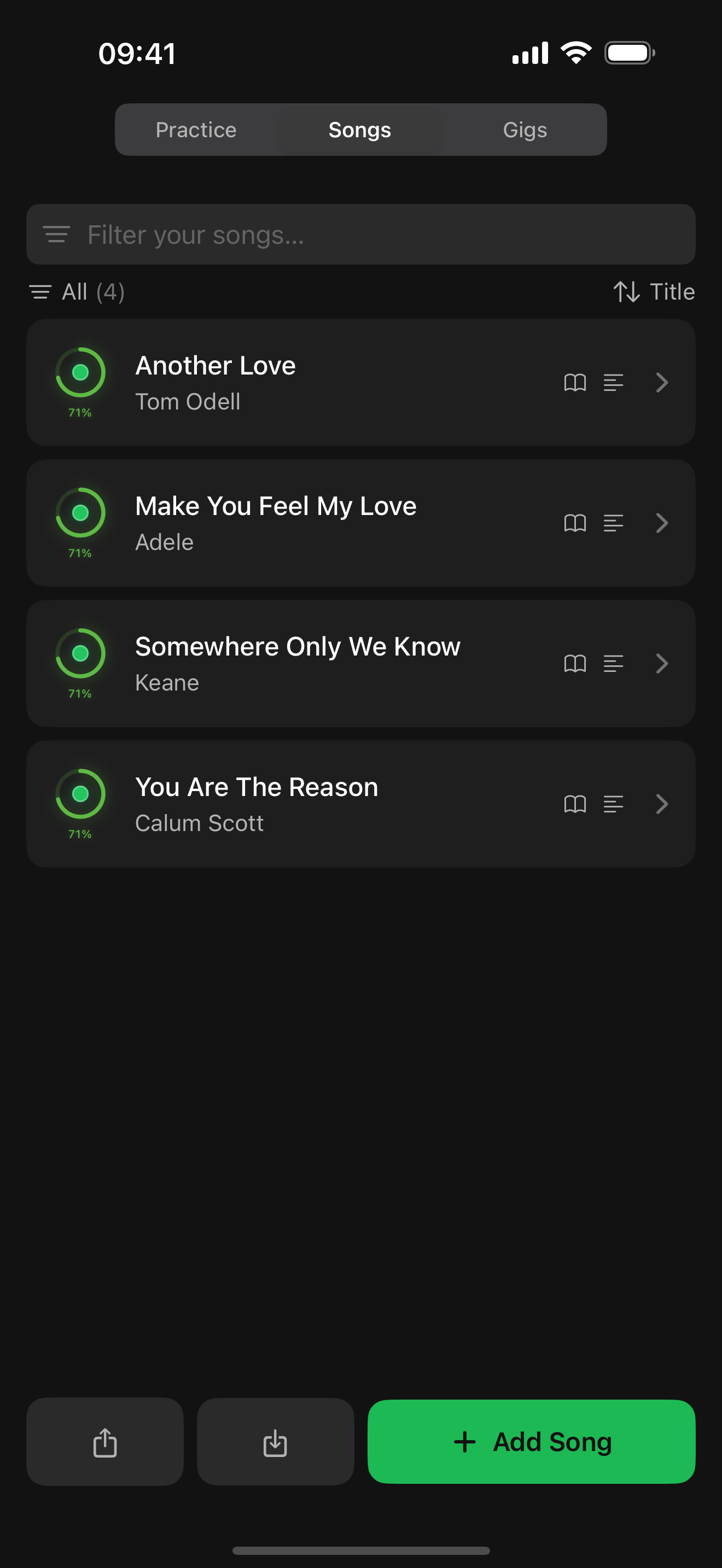
Together these two signals give you what a pure algorithm cannot: the self-knowledge that comes from accurate metacognitive monitoring, combined with an external check that keeps that self-knowledge honest.
Putting it together
The learning science here is not new. Spaced repetition has been known to work since Ebbinghaus. The testing effect was established in the early twentieth century. What Stage Proof does is apply this evidence systematically to a domain — song lyric memorization — where it has never been applied with any rigor before, and wrap it in an experience that is genuinely enjoyable to use.
The result is that musicians who practice with Stage Proof are not just passively accumulating familiarity. They are building retrieval fluency — the ability to produce the right words, in the right order, without musical scaffolding, under cognitive load, in real time. Which is, in the end, the only metric that matters when the spotlight comes on.
Ready to practice smarter?

References
- Ebbinghaus, H. (1885). Über das Gedächtnis: Untersuchungen zur experimentellen Psychologie. Duncker & Humblot. (English translation: Memory: A Contribution to Experimental Psychology, 1913.)
- Koriat, A., & Bjork, R. A. (2005). Illusions of competence in monitoring one's knowledge during study. Journal of Experimental Psychology: Learning, Memory, and Cognition, 31(2), 187–194.
- Roediger, H. L., & Karpicke, J. D. (2006). Test-enhanced learning: Taking memory tests improves long-term retention. Psychological Science, 17(3), 249–255.
- Karpicke, J. D., & Roediger, H. L. (2008). The critical importance of retrieval for learning. Science, 319(5865), 966–968.
- Wozniak, P. A., & Gorzelanczyk, E. J. (1994). Optimization of repetition spacing in the practice of learning. Acta Neurobiologiae Experimentalis, 54(1), 59–62.
- Cepeda, N. J., Pashler, H., Vul, E., Wixted, J. T., & Rohrer, D. (2006). Distributed practice in verbal recall tasks: A review and quantitative synthesis. Psychological Bulletin, 132(3), 354–380.
- Rohrer, D., & Taylor, K. (2007). The shuffling of mathematics problems improves learning. Instructional Science, 35(6), 481–498.
- Bjork, R. A. (1994). Memory and metamemory considerations in the training of human beings. In J. Metcalfe & A. Shimamura (Eds.), Metacognition: Knowing About Knowing (pp. 185–205). MIT Press.
- Hamari, J., Koivisto, J., & Sarsa, H. (2014). Does gamification work? A literature review of empirical studies on gamification. Proceedings of the 47th Hawaii International Conference on System Sciences.
- Deci, E. L., & Ryan, R. M. (1985). Intrinsic Motivation and Self-Determination in Human Behavior. Plenum Press.
- Perani, D., Saccuman, M. C., Scifo, P., Spada, D., Andreolli, G., Rovelli, R., … Kotz, S. A. (2010). Functional specializations for music processing in the human newborn brain. Proceedings of the National Academy of Sciences, 107(10), 4758–4763.
- Peretz, I., Radeau, M., & Arguin, M. (2004). Two-way interactions between music and language: Evidence from priming recognition of tune and lyrics in familiar songs. Memory & Cognition, 32(1), 142–152.