Why Stage Fright Makes You Forget Lyrics (And What to Do About It)
You knew those lyrics cold. Three hours ago in your living room, you ran the whole song without a stumble. Now you're standing in a spotlight and verse two has simply ceased to exist.
This is not a memory failure. It is a chemistry experiment happening inside your skull — one that your current practice routine almost certainly isn't designed to counteract. Understanding why it happens is the first step toward fixing it.
What actually happens in your brain when you're nervous
The moment your brain perceives a threatening situation — and standing alone under a spotlight in front of an audience qualifies — it triggers the hypothalamic-pituitary-adrenal (HPA) axis, flooding your bloodstream with cortisol and catecholamines including adrenaline (epinephrine) and noradrenaline.1 This is the classic fight-or-flight response, and for most of human history it was enormously useful. For memorized lyrics, it is a disaster.
The prefrontal cortex (PFC) — the region responsible for working memory, focused attention, and the deliberate, controlled retrieval of learned information — is exquisitely sensitive to stress hormones. Cortisol and adrenaline at high concentrations actively suppress PFC function.2 The same cognitive machinery you depend on to pull the next line out of storage gets partially taken offline precisely when you need it most.
Meanwhile, the amygdala — the brain's threat-detection circuit — becomes hyperactive under the same hormonal conditions. Neuroscientist Joseph LeDoux showed that the amygdala can trigger full-scale stress responses faster than the conscious brain can process what's happening, a dynamic sometimes called "amygdala hijack."3 The result is a negative feedback loop: the awareness that you might forget makes you more anxious, which suppresses PFC function further, which makes retrieval harder, which makes you more anxious.
Key finding: Lupien et al. (2007) reviewed the neurobiological literature on stress and memory and found that stress-induced cortisol elevation reliably impairs both the retrieval of existing memories and the encoding of new ones — with the strongest effects on declarative memory tasks that depend on the hippocampus and prefrontal cortex.1 Lyrics are declarative memory. This is not a coincidence.
Why lyrics are the first thing to go
Memory researchers distinguish between two broad systems that work very differently under stress. Declarative memory stores facts and sequences — information you can consciously describe, like the words of a song in order. Procedural memory stores automated motor skills — the muscle memory that moves your fingers across guitar strings or controls your vocal technique — which is processed through the basal ganglia and cerebellum rather than the hippocampus and PFC.4
Here is the crucial asymmetry: procedural memory is largely stress-resistant. The basal ganglia and cerebellum are not significantly impaired by elevated cortisol. Declarative memory, which depends heavily on hippocampal–PFC circuits, is highly stress-sensitive.1 This is why an experienced performer's hands keep playing even when their mind goes blank. The fingers remember. The words evaporate.
Lyrics live in declarative memory — they're a verbal sequence that has to be retrieved consciously and in order. Every verse, every bridge, every tricky third line of the second chorus: these are all explicit memories, catalogued as facts, and they are sitting directly in the path of the stress hormones your body is producing right now.
Key finding: Beilock & Carr (2001) demonstrated that choking under pressure — the sudden performance collapse in high-stakes situations — is specifically associated with tasks that rely on working memory and controlled, step-by-step processing.5 Tasks that have become sufficiently automated are largely immune. Their studies focused on golf and mathematics, but the mechanism is identical for lyric recall: the more your retrieval depends on active, effortful working memory, the more vulnerable it is to pressure.
The Yerkes-Dodson law: the sweet spot you're missing
Not all arousal is bad. In 1908, psychologists Robert Yerkes and John Dodson established what became one of the most cited findings in performance psychology: the relationship between arousal and performance follows an inverted U-curve.6 Too little arousal — you're bored, under-rehearsed, barely engaged — and performance suffers. Too much — you're flooded with cortisol, PFC is suppressed, amygdala is running the show — and performance collapses. The peak is in the middle: enough arousal to be energized and focused, not so much that the system overloads.
Yerkes–Dodson Performance Curve
The practical implication is this: a certain amount of pre-show nervousness is not just normal, it's useful. It sharpens focus and raises energy. The problem is that most musicians who blank on lyrics have crossed well past the optimal zone into the overloaded region — where cortisol suppression of the PFC means that even well-practiced lyrics can't be retrieved reliably.
The solution is not to eliminate nerves (impossible, and counterproductive even if you could). The solution is to build memories that are robust enough to survive retrieval under suppressed-PFC conditions — which requires a completely different approach to practice than most musicians use.
Overlearning: building stress-resistant memory pathways
When cognitive psychologists talk about making a memory "stress-resistant," they are describing a process called overlearning — continuing to practice beyond the point of first successful recall, until retrieval becomes automatic rather than effortful.7 A memory that requires active, working-memory-intensive retrieval is fragile under stress. A memory that has been retrieved correctly hundreds of times becomes proceduralized — it starts to behave more like a motor program, requiring less prefrontal involvement to execute.
This is exactly what Beilock and Carr found: performers who had over-practiced a skill to the point of proceduralization showed no performance degradation under pressure, while those who still depended on effortful, step-by-step recall choked.5 The threshold for overlearning is far higher than most musicians realize. Knowing a lyric well enough to recite it once, correctly, in a quiet room — is nowhere near sufficient. You need to retrieve it correctly, repeatedly, across multiple sessions, with the difficulty deliberately varied.
The most effective method for reaching this threshold is retrieval practice: repeatedly testing yourself on the material rather than re-reading it. Every successful retrieval attempt strengthens the neural pathway used to access that memory, making it more efficient and more resistant to interference from stress hormones.8 And critically — the harder the retrieval attempt (the more effort required, the less scaffolding provided), the stronger the resulting memory trace. This is the principle of desirable difficulty: the cognitive work that feels unpleasant during practice is precisely what makes the memory robust under pressure.

How Stage Proof builds stress-resistant memory
Stage Proof's practice system is built specifically around the mechanisms that produce stress-resistant recall — not just any recall.
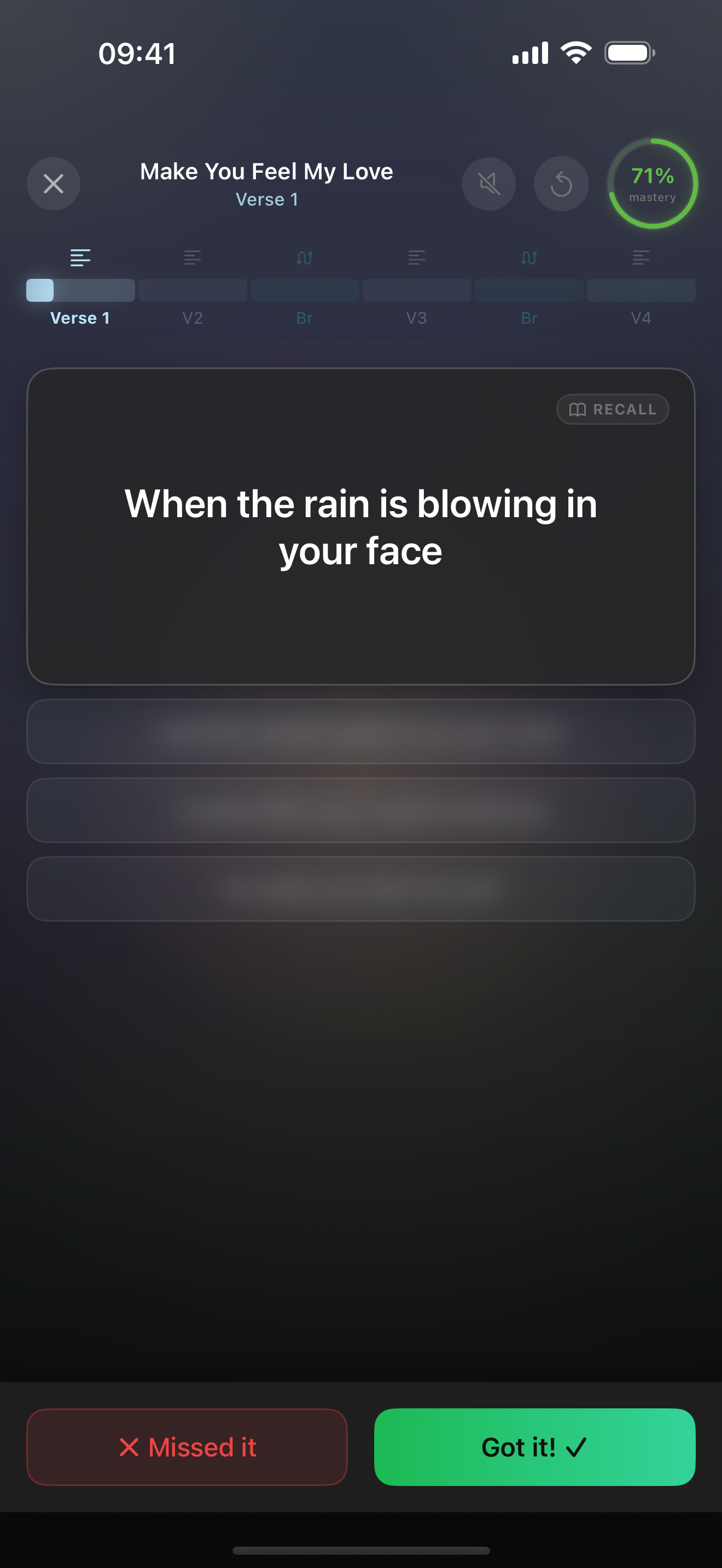
Active retrieval, not passive review. Every practice session in Stage Proof forces you to produce the lyrics rather than recognize them. Free recall (attempt the line before seeing it), sentence builder (reconstruct it from word tiles), fill in the blank — these are all high-effort retrieval formats. The harder the format, the more overlearned the memory becomes after repetition. Reading your lyrics in a notes app is doing nothing useful here.
Spaced repetition targeting weak lines. Retrieval practice only builds stress resistance if the practice is sustained over time. A single intensive session produces familiarity; distributed practice across multiple days produces the deep encoding that can survive a cortisol spike. Stage Proof tracks mistakes at the individual line level and focuses each session on the weakest sections — the ones with the lowest mastery score, specifically the lines that have tripped you up in previous sessions. That bridge in verse three that always trips you up will come back until it no longer does.
Varied formats break PFC dependence. Interleaving multiple exercise formats for the same line forces the brain to build multiple retrieval pathways. A line that can only be recalled with a musical cue or a visual scaffold (e.g., "it's the third line after the chorus") relies on a single fragile retrieval route. A line that has been retrieved in free recall, as a word-tile reconstruction, and as a fill-in-the-blank exercise has at least three independent routes into the same memory — and all three have to fail simultaneously for the line to go blank.
Why this matters under pressure: Roediger & Karpicke (2006) showed that students who studied using retrieval practice retained 61% of material a week later, versus 40% for repeated re-reading — a 50% relative improvement.8 But the gap widens further under stress. When PFC resources are compromised, memories built through effortful retrieval are accessed through more automatic pathways that require less prefrontal involvement to fire. Re-read memories have no such backup.
The safety net for when it still happens
Even correctly built memories can fail when arousal is high enough. Beilock and Carr's choking data show that even overlearned skills have a breaking point at extreme pressure, though that point is substantially higher than for under-practiced skills.5 The goal of practice is to raise your threshold, not pretend you're immune.
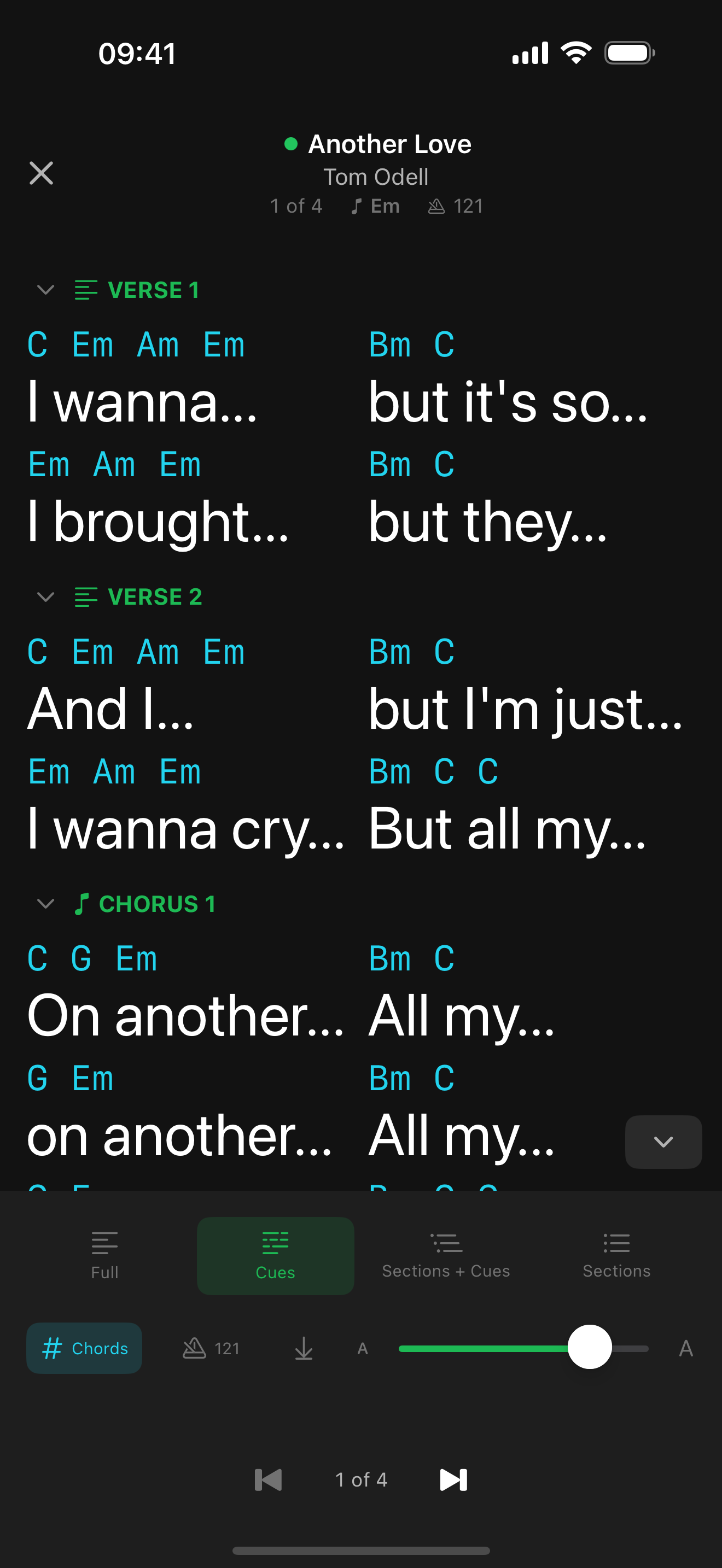
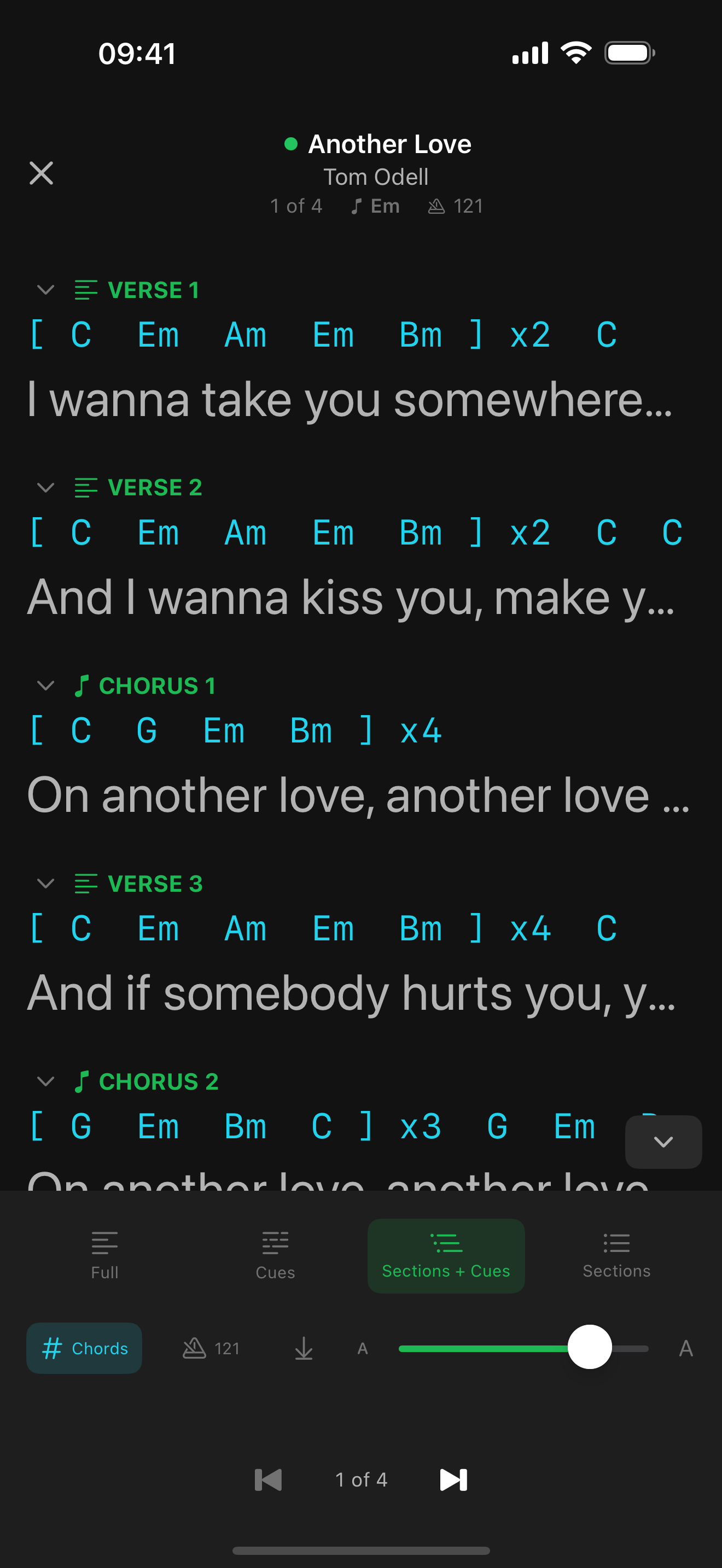
Stage Proof's Performance Mode is designed for exactly this scenario — not as a crutch to replace practice, but as a precisely calibrated safety net. The key insight is that you want the minimum amount of visual information needed to trigger the memory, not a full teleprompter that shifts your retrieval strategy back to recognition and pulls your attention off the audience.
Cues mode — first words of each line only — works on this principle. A single-word cue is usually enough to prime the retrieval pathway for a well-practiced line; it doesn't replace the memory, it starts it. Section markers give you a structural anchor if you lose your place. Full lyrics are there if you need them — but if you've done the retrieval practice, you'll rarely need to read past the first word.
The honest answer about nerves
None of this eliminates stage fright. Nor should it. The arousal that comes from performing in front of people — the heightened state, the sharpened attention, the sense that this matters — is part of what makes live performance feel alive for both the performer and the audience. The Yerkes-Dodson curve is real: you want to be on the ascending slope, not the flat baseline of someone who doesn't care.
What you can change is where your breaking point is. A musician who has rehearsed each lyric through dozens of varied retrieval attempts, across multiple sessions, over multiple days, has built memories that sit much closer to the procedural end of the spectrum — memories that require less prefrontal involvement to fire, that are less dependent on the cognitive resources stress hormones suppress. When the cortisol arrives, those memories survive. The ones built by reading are the first to go.
The difference between a performer who blanks and one who doesn't is rarely talent. It is almost always the quality of the practice method.
Build lyrics that hold up under pressure.

References
- Lupien, S. J., Maheu, F., Tu, M., Fiocco, A., & Schramek, T. E. (2007). The effects of stress and stress hormones on human cognition: Implications for the field of brain and cognition. Brain and Cognition, 65(3), 209–237.
- Arnsten, A. F. T. (1998). Catecholamine modulation of prefrontal cortical cognitive function. Trends in Cognitive Sciences, 2(11), 436–447.
- LeDoux, J. E. (1996). The Emotional Brain: The Mysterious Underpinnings of Emotional Life. Simon & Schuster.
- Squire, L. R. (2004). Memory systems of the brain: A brief history and current perspective. Neurobiology of Learning and Memory, 82(3), 171–177.
- Beilock, S. L., & Carr, T. H. (2001). On the fragility of skilled performance: What governs choking under pressure? Journal of Experimental Psychology: General, 130(4), 701–725.
- Yerkes, R. M., & Dodson, J. D. (1908). The relation of strength of stimulus to rapidity of habit-formation. Journal of Comparative Neurology and Psychology, 18(5), 459–482.
- Driskell, J. E., Willis, R. P., & Copper, C. (1992). Effect of overlearning on retention. Journal of Applied Psychology, 77(5), 615–622.
- Roediger, H. L., & Karpicke, J. D. (2006). Test-enhanced learning: Taking memory tests improves long-term retention. Psychological Science, 17(3), 249–255.